Robbie Thain
Founder, CEO

AB InBev reported twice the ROI from integrated marketing. Makai examines the claim and its implications for staffing, field execution, and measurement.

On October 21, 2026, AB InBev Global CMO Marcel Marcondes reported a stronger return from the company’s integrated marketing approach at the ANA Masters of Marketing conference. He said Return on Investment (ROI) was “two times higher” than when trade and media ran separately, according to coverage of his presentation.
The operational story behind that statement matters to beverage and CPG marketers. Marcondes described connecting sponsorships with media and packaging, retail execution and live experiences. His reported result puts the relationship between those activities at the center of the business case.
The change Marcondes described was in how AB InBev organized its marketing model. Rather than treating a sponsorship as logo placement alone, the company connected it to consumer interests and relevant beer occasions. Commercial execution was part of the model rather than a separate activity alongside it.
Food Dive reported that AB InBev calls these connected sponsorships and partnerships “mega platforms.” Its coverage described a model spanning sports and music alongside streaming and travel experiences. For the World Cup, the publication reported that Michelob Ultra combined media and packaging with trade marketing and experiential marketing.
The execution figures show the scale of that example. Conference coverage reported that Michelob Ultra ran almost 40,000 U.S. activations across the 11 host cities for the 2026 FIFA World Cup. Those activations reportedly reached more than 2 million consumers.
The same report cited company statements that Michelob Ultra’s U.S. on-premise distribution rose 13% and retail display activity rose 20% in connection with the tournament. These are commercial measures alongside the activation and reach figures.
The ROI figure is company-reported, not an independently verified benchmark. Public coverage does not disclose the calculation or attribution method, the measurement period or sample, or whether budgets were equivalent. The primary account compares integrated activity with separate trade and media; Food Dive describes the comparison as traditional media. The coverage also does not establish that the integrated model caused the reported commercial changes.
The useful distinction is between a reported return and an operating principle. The former belongs to AB InBev’s presentation. The latter gives other brand teams a concrete planning question: how closely are their live experiences connected to the rest of their commercial activity?
At Makai, we welcome the focus on connected execution. We believe a consumer experience should feel warm and natural while the work behind it stays disciplined. A good conversation deserves more than an isolated attendance count in a recap deck.
We have connected brands with people through live experiences and retail programs since 1995. Across more than 1,000 campaigns in all 50 states, our experience spans different products and audiences as well as retail settings and market conditions. That range informs our view: integration must make sense where the interaction happens, not just where the campaign is presented.
Our experiential campaigns and trade show activations are designed to turn brief consumer interactions into qualified leads for premium CPG brands. That positioning makes the handoff from attention to commercial interest central to the work. The experience and its business purpose belong in the same brief.
For a food or beverage brand, product trial and qualified pipeline are different objectives. Both can matter without being treated as interchangeable. We believe connecting event goals to business outcomes starts with naming the outcome the activation is intended to support.
Our reaction to AB InBev’s report is therefore practical: welcome the integration principle without borrowing the reported return as a forecast. A brand’s own business case needs its own definition of success.
For Makai, the operating implications start with the connections between people and places. Our services span trained retail ambassadors and trade show environments alongside permitting and CRM reporting. Looking across those responsibilities gives the integration principle a practical frame beyond the sponsorship announcement.
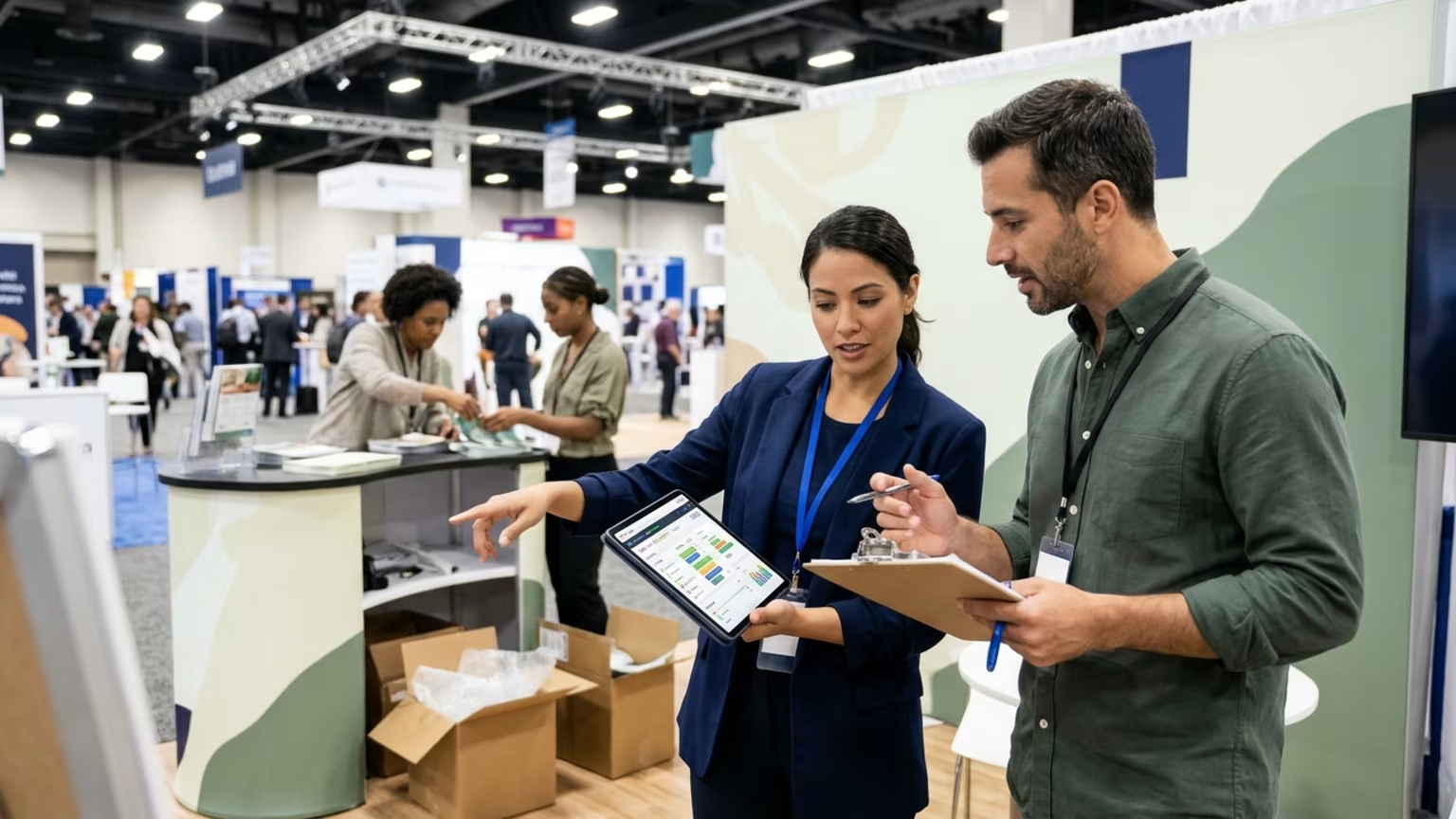
Makai’s retail demonstrations use trained brand ambassadors to support in-store sales through conversations and product trials. Our trade show work focuses on spaces that attract attention and start conversations. These are related capabilities, but the commercial purpose of each interaction still needs to be clear.
Our view is that staffing discussions should begin with that purpose rather than headcount alone. A consumer tasting and a conversation intended to produce a qualified lead ask different things of the interaction. The staff brief should express the intended connection between participation and the commercial outcome.
This is where aloha meets discipline. The welcome stays human. The business objective stays clear.
Scattered attention and poor booth flow are among the problems Makai addresses. We plan and manage trade show spaces around attracting attention and converting conversations into customer opportunities.
Applied to this story, our recommendation is to evaluate the footprint as part of the connected experience. The product encounter should have a clear relationship to whatever commercial action the program is designed to support. An impressive structure does not answer that question on its own.
That same principle matters when an activation extends beyond its main footprint. Our perspective on connecting onsite experiences with activity beyond the booth keeps the discussion focused on the relationship between touchpoints rather than their size.
Makai’s capabilities extend from permitting to CRM reporting. We also store sampling products and event gear, then coordinate shipping and tracking with nationwide delivery. Those responsibilities sit behind the physical encounter that consumers see.
We believe an integrated campaign deserves an integrated operating discussion. The proposed experience and its delivery requirements should be evaluated together rather than treated as separate creative and logistics topics. That is a planning stance, not a prescription for a particular permit or staffing arrangement.
The relevant question is whether the operating scope supports the intended experience across the settings selected. A connected campaign needs more than a consistent visual identity; it also needs an executable physical presence.
The AB InBev coverage includes activation counts and consumer reach alongside distribution and retail display measures. Those categories serve different purposes in an evaluation. Keeping them distinct is part of the research’s practical lesson.
For Makai, measurable sales pipeline is part of the purpose of face-to-face marketing. Our integrated service scope includes CRM reporting because the commercial discussion does not end when the interaction ends.
In that context, connecting lead capture with CRM reporting is a relevant operational consideration. A report should distinguish participation from qualified interest and from the commercial outcome being evaluated. Calling every interaction a lead would blur the very connection the business case needs to explain.
Marcondes said AB InBev was moving “from being just an advertiser to becoming a full experience provider,” according to the conference reporting. Food Dive also reported his view that providing or participating in experiences can build an emotional connection as well as a rational one.
For Makai, that framing fits the purpose of hands-on brand moments: connect emotionally rather than simply put a message in front of someone. We believe the discipline is to carry that purpose into the commercial evaluation without reducing the human interaction to a scan count.
The creative experience and the measurement question do not need to compete. They need to describe the same program.
The practical response is not to insert AB InBev’s reported return into another brand’s forecast. It is to make the proposed connection between experience and commercial performance explicit.
The research supports asking for these elements in the business case:
That is a more useful executive discussion than treating a busy footprint as proof of value. It also keeps the ambition of the experience tied to the evidence the team intends to collect.
As a CMO or VP of Marketing, will you review your next activation brief today to identify exactly how participation connects to the commercial outcome you plan to measure?
After an integrated activation brief is approved, the work shifts to hands-on brand moments that Makai creates to connect emotionally and turn customers into ambassadors. For CPG teams facing difficulty measuring live-event ROI, Makai’s experiential campaigns and trade show activations focus on turning brief consumer interactions into qualified leads rather than vanity metrics.

30 Years Experiential & Retail Activation Partner for CPG & Beverage Brands | Multi-Market Demos, Roadshows & Costco/Club Programs That Actually Sell