Robbie Thain
Founder, CEO

A major U.S. grocery chain is expanding its vendor-funded demo program with strict performance reporting. Learn how to prove ROI and drive retail sales.

A major U.S. grocery chain recently expanded its vendor-funded demo program with strict new performance reporting requirements. Food and beverage brands must now prove their in-store sampling drives immediate trial and long-term repeat purchases to justify field marketing budgets.
Imagine a crowded grocery aisle on a busy Saturday afternoon. A brand ambassador hands out organic cheese samples to passing shoppers. People take a sample, nod with a polite smile, and keep walking down the aisle. The regional sales manager later asks the marketing director how many of those samples turned into actual sales.
The marketing director stares at a spreadsheet full of empty cells and vague foot traffic estimates. Retailers no longer accept the old way of doing things. Store buyers want hard data showing that your field marketing investment moves units off their shelves. They demand proof that an activation drives immediate trial and supports new product launches with measurable lift.
Without this data, brand managers face intense pressure from retail partners. These demands are not temporary trends. Retailers operate on razor-thin margins, and they rely on vendor-funded programs to drive their own store profitability. When a brand takes up prime real estate near the front doors, that space must generate maximum revenue.
Shopper marketing teams can no longer hide behind vanity metrics like social media impressions or total samples distributed. Store management wants to know exactly how your presence affected their bottom line that day. The recent announcement from a major U.S. grocery chain makes this new standard clear. They are expanding their vendor-funded demo program across high-traffic stores.
But this expansion comes with a massive catch. Brands must supply strict performance reporting, including conversion metrics and repeat purchase tracking. Gone are the days of counting empty sample cups and guessing the impact. Retail buyers want to see your Return on Investment in plain numbers.
If you cannot provide a clear link between a tasting and a transaction, you will lose your prime promotional slots. This shift leaves many field marketing teams scrambling for solutions. They are used to planning events based on aesthetics and basic foot traffic numbers. Now they must operate like performance marketers who track every single interaction.
The pressure is on CPG marketing teams to adapt fast. If they fail to provide concrete numbers, the retailer will simply give that valuable floor space to a competitor who can prove their worth.
Success under these new rules requires a total operational reset. Brands must shift their mindset from generating mere awareness to driving predictable retail performance. This means treating every in-store activation as a measurable sales channel. You must plan the data collection strategy before you book the first store date.
The core approach centers on aligning your field execution with retailer point-of-sale systems. You need to know the baseline sales velocity for your product at each specific location. You track units sold during the activation hours and compare them to that baseline. Then you monitor the following weeks to measure repeat purchase patterns.
This framework relies on strict operational discipline on the floor. Brand ambassadors cannot just be friendly faces handing out food. They must be trained sales professionals who guide the shopper toward the shelf and close the interaction. Every detail matters, from the table placement to the exact script used to prompt a purchase.
To pull this off, you need clean campaign data flowing from the field to your management team. This strategic shift requires a much tighter relationship with the store management team on the ground. Your field staff must arrive prepared, introduce themselves to the store director, and clearly communicate their goals. A well-organized team builds goodwill with store employees, which often leads to better placement and extra support.
When the store staff sees your ambassadors actively driving sales, they become advocates for your brand. This grassroots relationship building is a critical part of the overall strategy. Real-time reporting allows you to fix poor execution immediately. If a particular store underperforms on a Friday afternoon, you adjust the strategy for Saturday morning.
You might change the sampling portion size, tweak the opening hook, or move the table closer to the dairy case. This level of control turns a chaotic sampling program into a reliable revenue engine. It gives brand managers the confidence to sit in front of a retail buyer and present undeniable proof of performance.
Meeting these strict retailer reporting demands requires a flawless field strategy. You need a reliable system that bridges the gap between the tasting table and the checkout lane. Uncoordinated staffing and poor inventory management will destroy your conversion rates. Here is the exact playbook we use to execute high-converting sampling campaigns.
This operational checklist keeps your entire team focused on the numbers that matter to the retailer. Every step reinforces the goal of proving your program pays for itself. For a deeper look into preparation, review a comprehensive event execution framework to keep your logistics tight.
Retailers expect you to speak their language. They want to see specific performance indicators that prove your investment is working. You must track both the immediate actions on the floor and the long-term sales impact. Lead metrics tell you if the activation is running smoothly, and lag metrics prove the actual business value.
Your lead metrics must capture the true quality of the live interaction. Track the total number of engagements, not just passing glances. Measure the sample-to-interaction ratio to see if your product is actually appealing to the crowd. You must monitor the units sold during the live demo hours to gauge immediate conversion.
A strong field team will track these numbers hourly to keep the event on pace. If the conversion rate drops, the field manager can step in and correct the ambassador's approach. The lag metrics are what you present to the retail buyer at your next meeting. Calculate your exact sales lift percentage by comparing the demo day volume against your historical baseline.
Track the cost per acquisition by dividing your total activation spend by the net new customers acquired. Provide the retailer with data on the repeat purchase rate over a thirty-day window. These lag metrics show the true long-term value of your field marketing efforts. Another valuable metric is the brand conversion ratio among new shoppers versus returning customers.
You want to know if your sampling program is attracting entirely new buyers or just subsidizing purchases for existing fans. By pairing your field data with loyalty card insights from the retailer, you can track this exact breakdown. Brands that bring fresh shoppers into a specific category hold immense power during annual vendor negotiations. Presenting clean, accurate data builds massive trust with your retail partners.
They will prioritize brands that make their jobs easier and their stores more profitable. A buyer who sees consistent sales lift from your events will gladly approve future promotional dates. If you want to expand your shelf space, you must prove your value through rigorous reporting.
We have executed over 1000 campaigns across all 50 states, bringing brands to life in every major U.S. market. From retail demos in Seattle to roadshows in Miami and events in Honolulu, our teams activate brands wherever our clients' audiences are located. This national footprint gives us a front-row seat to shifting retailer expectations. We see exactly what top grocery chains demand from their vendor partners.
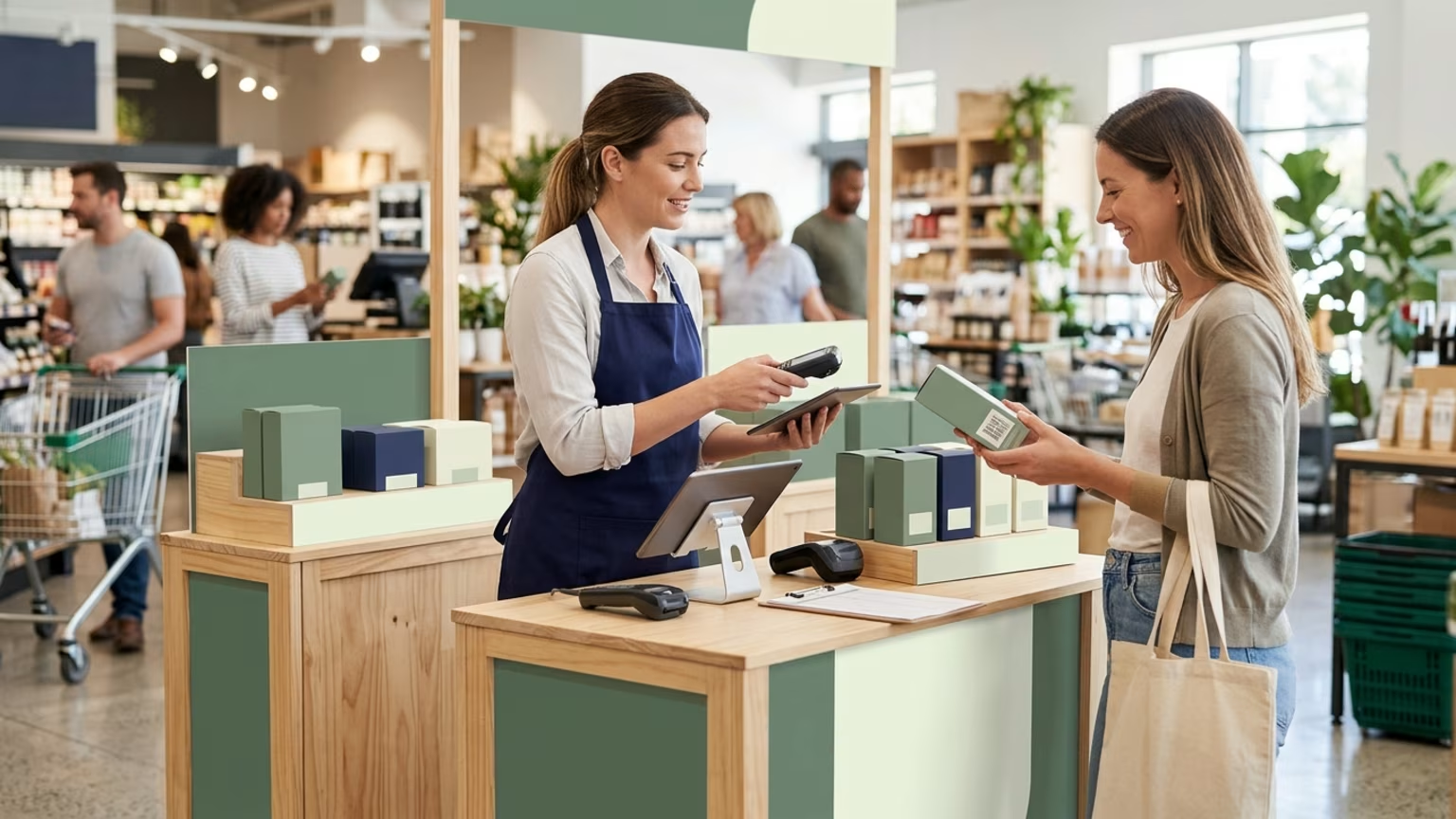
Recently, a premium beverage brand approached us right after a major grocery chain updated its vendor funding rules. The brand was terrified of losing its promotional status if it could not prove a positive Return on Investment. The old field agency they used provided no digital tracking and zero sales integration. We deployed our trained ambassadors to fifty high-traffic locations with a strict new data capture protocol.
Every ambassador carried a digital reporting tool to log inventory levels and hourly interactions. Our team tracked every sample poured, every shopper conversation, and every unit moved off the shelf in real time. We matched our field logs with the retailer point-of-sale data at the end of each weekend. The program generated a massive immediate sales lift and established a clear pattern of repeat purchases over the next month.
The beverage brand finally had the hard evidence it needed to satisfy the retailer. This exact scenario plays out every week across the country. Brands that refuse to adapt their reporting systems find themselves locked out of top retail doors. They lose their vendor-funded slots to younger, more agile competitors who understand the power of clean data.
The brands that win are the ones that adopt a ruthless focus on measurable outcomes. They view every tasting table as an opportunity to generate immediate revenue and secure long-term buyer trust. The brand manager took our final performance report straight to the category buyer. The data was so conclusive that the retailer actually offered the brand expanded placement in fifty additional stores.
This is what happens when you treat live activations as a precise science rather than a guessing game. If you want to build a data-backed sampling program for your brand, you should book a strategy call with our team today.

30 Years Experiential & Retail Activation Partner for CPG & Beverage Brands | Multi-Market Demos, Roadshows & Costco/Club Programs That Actually Sell