Robbie Thain
Founder, CEO

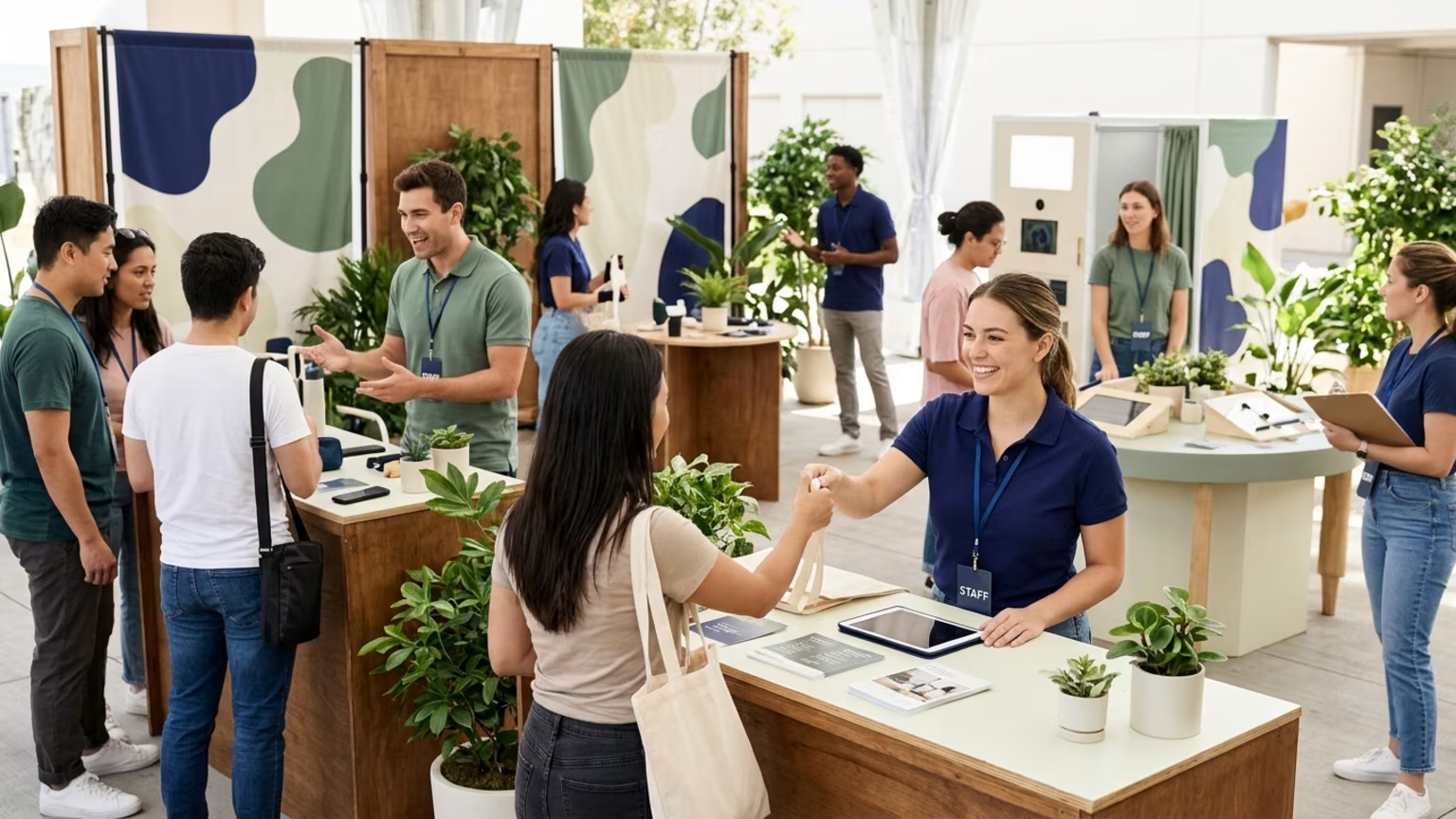
Hire brand ambassadors for real shopper interactions with practical role-plays, role-specific briefs and reporting tied to meaningful outcomes.

Your most enthusiastic brand ambassador may be your weakest hiring decision. High energy is not evidence that someone can explain a product accurately or listen to a rushed shopper. It says even less about whether they know when to stop talking and ask for help.
Enthusiasm belongs on the team. It should not write the job description. For experiential marketers under pressure to prove Return on Investment (ROI), the better hiring question is not “Who lights up the interview?” It is “Who can handle the consumer interaction this activation actually needs?”
The expensive mistake is approving a polished activation while leaving its human interaction vague. A compelling space and an upbeat crew do not answer a CMO’s hardest question: what did this spending produce?
Without a defined assignment, a crowded booth can conceal an empty qualification process. One person counts every passerby while another counts only completed conversations. The recap looks busy but the pipeline remains difficult to defend.
One practitioner staffing guide recommends working backward from the conversation a visitor should have. It advises defining responsibilities and decision authority before assigning people. That is a more useful starting point than headcount and an hourly rate.
Reading a training deck is not proof of readiness, the same guidance argues. A hiring conversation should therefore lead toward an observable task rather than a promise to “be great with people.” That is the foundation of staffing around the actual work, not just filling shifts.
These sources provide practitioner recommendations, not controlled evidence that a particular hiring test increases sales. The practical case here is narrower: use work samples to inspect job-relevant behavior before putting someone in front of customers.
At Makai, we believe warmth and operational discipline belong together. Aloha is not a substitute for accuracy. It is a reason to treat people with respect while staying honest about the product and the next step.
We have connected brands with people through live experiences and retail programs since 1995. Across our history, we have delivered more than 1,000 campaigns in all 50 states for more than 200 brands. That experience spans different products and audiences rather than a single activation format.
Our retail demonstrations use trained brand ambassadors and real product conversations with in-store sales as the objective. We see a useful hiring brief as a bridge between that human exchange and the work required to deliver it.
A Director of Brand Strategy in the CPG snack division shared: "The Makai team turned our product launch into a sensory event that shoppers still talk about. From creative storytelling to flawless in-store execution, they made snack time unforgettable. We couldn't have asked for a stronger partner."
The practitioner guidance recommends a readiness demonstration covering an accurate explanation and a relevant question. It also calls for delivering the activity and guiding the visitor toward an appropriate next step. Adapt that logic into a consistent interview work sample using the same concise approved brief for each candidate.
Useful prompts include:
Assess accuracy and clarity alongside listening. Look for appropriate escalation and a clear next step. Keep those criteria consistent rather than rewarding whichever candidate delivers the most entertaining performance.
Simple sampling and complex demonstrations should not share an identical audition. The staffing guidance distinguishes a sampling station from a demonstration that may need specialist expertise plus queue and follow-up coverage. Assess the responsibilities being hired for rather than expecting every candidate to cover every role.
For a sampling assignment, listen for a clear invitation and an accurate explanation. For a complex demonstration, add a hands-on walkthrough and a participant who gets stuck. The candidate’s response should stay within approved information while keeping the next step clear.
An agency guide to marathon activations recommends rapid engagement drills and practice in a loud setting when possible. It also distinguishes course-side interactions from expo work. The useful lesson is to rehearse the setting the ambassador will face rather than rewarding one generic performance style.
Audience fit also deserves a scenario. Ask how the candidate would respond to a participant requesting a language or accessibility adjustment. Assess the response against the support and escalation routes defined for that activation.
The assignment includes more than the moment a shopper smiles. The staffing guidance includes setup and replenishment alongside handoffs and reporting. Ask candidates to explain their responsibilities and identify who handles an operational problem or a question outside the brief.
For us, consistent execution across physical settings belongs in the same conversation as creative design. At Natural Products Expo West 2025, we designed and managed a 40 by 20 foot trade show environment for Glanbia. Our scope covered concept and operations as well as staffing and breakdown. More than 14,000 recorded product samples were distributed across the activation stations.
The hiring lesson is not that a larger space demands a louder personality. It is that the brief must describe the work inside the space. Creative ambition does not remove the need for clear responsibilities.
Impressions describe exposure. They do not describe whether an ambassador delivered the assigned interaction. Hiring should begin with the outcome the person can reasonably influence and reporting should use the same definition.
That does not mean turning every shopper conversation into aggressive lead capture. A retail demonstration may be intended to support trial and an in-store purchase. A trade-show assignment may call for a qualified buyer conversation and a retail meeting.
Before recruitment starts, a role-specific scorecard might distinguish:
The practitioner guidance recommends separating meaningful interactions from foot traffic. It also calls for reporting observed execution quality and recurring questions along with operating interruptions. Those categories give a hiring manager something more useful to assess than confidence alone.
The same discipline applies when teams connect trial with a purchase opportunity. Ask candidates to describe what they would report after the interaction and what would require follow-up. The answer should match the assignment rather than inflate the activity count.
At our Glanbia activation, the recorded sample total establishes distribution activity. It does not establish buyer qualification or sales. Use that distinction in the brief: a sample is a sample and a requested meeting is a different outcome.
When the interview asks for an accurate explanation but the field report rewards only volume, the hiring standard and the job are pulling apart. Keep the assessment and the reporting focused on the same interaction. Otherwise the business question gets lost between recruitment and the recap.
Stop hiring the atmosphere and start assessing the assignment. Warmth makes room for a human exchange; operational discipline gives that exchange a clear job. Demand an accurate explanation and sound judgment before admiring the booth or the audition. A polished activation should support execution, not distract from its absence.
Measurable in-store response gives ambassador hiring a business purpose, and Makai supports that purpose with shopper conversations and product trials. For CPG marketers and food and beverage brand managers struggling to evaluate event ROI, its trained brand ambassadors conduct retail demonstrations focused on in-store sales.
30 Years Experiential & Retail Activation Partner for CPG & Beverage Brands | Multi-Market Demos, Roadshows & Costco/Club Programs That Actually Sell