Robbie Thain
Founder, CEO

Overstaffing drains your marketing budget, and understaffing limits sales. Learn a data driven field staffing model matching headcount to conversion capacity.
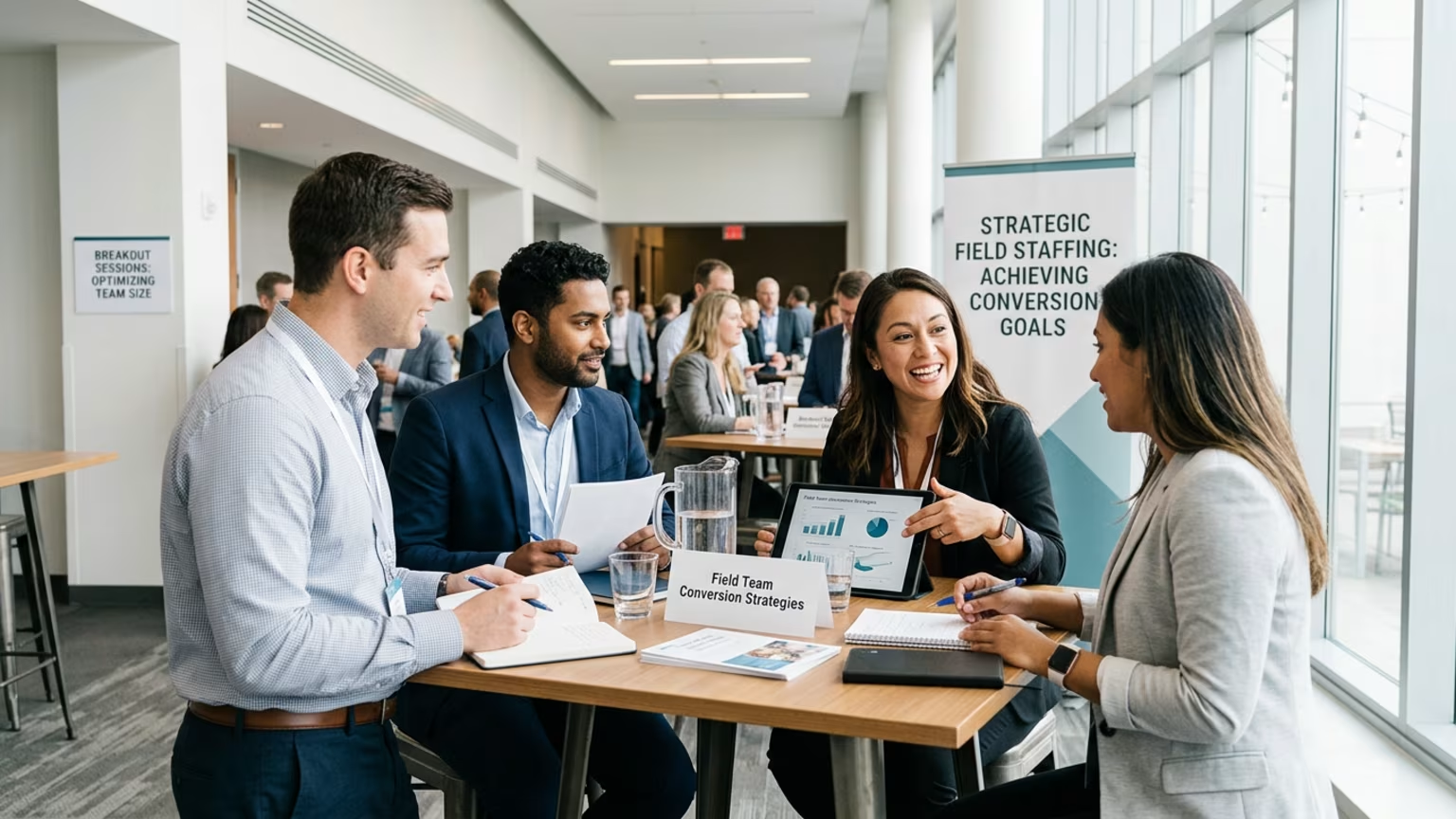
Industry data reveals that labor costs routinely consume up to forty percent of a standard experiential marketing budget. Treating those expensive hours as a fixed operational cost rather than a dynamic conversion engine actively destroys your overall campaign profitability.
Overstaffing drains your marketing budget with idle hands, and understaffing leaves valuable brand revenue on the trade show floor. This guide outlines a data driven staffing model that aligns your headcount directly with expected conversion rates and retail coverage needs.
Imagine an expansive expo center during a peak trade show day. Your brand has a massive island booth designed to attract thousands of active industry visitors. You hired eight brand ambassadors to staff the large footprint for the entire busy afternoon. By noon, three reps are huddled together talking, two are scrolling on their phones, and the remaining three are overwhelmed by a rush of eager buyers.
This operational disconnect happens repeatedly across grocery retail demos, massive industry expos, and sprawling campus events across the country. Brands often determine their event schedules based on physical footprint size rather than active engagement potential. Overstaffing bleeds your experiential marketing budget dry with idle hands and wasted hourly wages. Understaffing frustrates potential buyers who simply walk away after waiting too long for a product sample.
Both poor scenarios turn expensive live events into frustrating missed opportunities for your active sales pipeline. The modern field marketing manager must act as a true corporate revenue operator to prevent this exact operational waste. According to recent field marketing job listings across major corporate brands, senior operators are now expected to manage strict budget oversight and clear performance tracking rather than basic event coordination. Operators need a highly reliable system to align every scheduled hour with measurable brand outcomes.
Relying on sheer guesswork or outdated promotional agency formulas simply will not work in a modern retail environment. You must treat your active field team as a dynamic asset that scales directly with actual consumer demand. A disciplined mathematical approach to headcount separates successful brand activations from completely disorganized logistical nightmares. The real secret lies in forecasting true operational capacity before the promotional event ever begins.
The solution requires shifting from a spatial staffing model to a strict conversion capacity framework. Instead of assigning people per square foot, you assign them based on expected engagement volume and average interaction length. This mathematical method relies heavily on historical retail data and exact retailer guidelines to forecast actual labor needs. You stop guessing about headcount and start calculating the precise number of conversations needed to hit your final sales target.
We have executed over 1000 campaigns across all 50 states, bringing brands to life in every major U.S. market. From retail demos in Seattle to roadshows in Miami and massive events in Honolulu, our teams activate brands wherever our clients need a physical presence. Through this extensive geographical repetition, we learned that matching headcount to true foot traffic creates the most profitable foundation for any live campaign. We treat every field team like an extended family, but we run the event numbers with absolute operational discipline.
A successful framework divides your entire event team into highly specialized operational roles. You separate the team members actively closing direct sales from those managing inventory logistics or drawing initial crowds. When you assign distinct responsibilities across the booth, you stop paying premium hourly rates for basic support tasks. A lead closer requires a completely different communication skill set than a product replenisher.
You must then cross reference these specific roles against local labor market realities. High turnover regional markets require a wider bench of trained reserves to maintain consistent floor coverage. Building dependable rosters for national tours protects the brand from sudden staffing shortages during peak consumer selling windows. A highly stable team structure allows you to optimize overall costs without ever sacrificing the direct consumer experience.
Implement this exact framework by following a structured and repeatable operational sequence.
Review past engagement numbers for the exact venue before signing a contract. Identify peak traffic hours and expected lulls to build a baseline traffic model. Do not staff a Tuesday morning shift with the exact same headcount as a Saturday afternoon.
Calculate the average time it takes to deliver the brand pitch and process a sample. A two minute conversation limits one rep to thirty interactions per hour under perfect conditions. Use this strict mathematical cap to determine your maximum daily throughput per person.
Document every rule imposed by the venue or the specific store manager. Some grocery chains prohibit brand ambassadors from stepping away from the sampling cart for any reason. These strict rules require you to schedule dedicated runners for backroom inventory pulls.
Stagger individual shifts to align directly with expected traffic surges and overall event schedules. Avoid scheduling the entire promotional team for the exact same start and end times. Overlapping shifts during peak hours keeps the booth full when serious buyers are present.
Assign veteran staff to complex conversion conversations and direct buyer negotiations. Place newer associates on high volume distribution tasks to maximize your overall budget efficiency. Paying top tier hourly rates for simple flyer distribution ruins your baseline labor metrics.
Account for mandated lunch breaks, unexpected inventory runs, and unpredictable venue delays. A rigid schedule shatters the absolute moment a team member needs a sudden water break. Build an extra fifteen percent capacity into your schedule to absorb unexpected operational friction.
Equip the on site team lead with authority to send people home early if traffic completely dies down. You must empower local leaders to protect the event budget in real time. Dynamic scaling turns fixed labor costs into a highly controllable variable expense.
You need precise mathematical data to validate your staffing model against financial targets. Vague impressions and total foot traffic counts will not satisfy your finance department anymore. We focus heavily on tracking meaningful engagement data to prove the actual business value of your live experiences. Clear reporting separates top performing field teams from those just making noise.
Your lead metrics tell you if the team is operating efficiently on the active floor. Track the cost per interaction to understand the baseline financial expense of starting a real conversation. Monitor the rep utilization percentage to see how much time they spend actively engaging versus standing completely idle. Measure the sample distribution rate to verify the physical product moves at the mathematically expected pace.
Your lag metrics prove the true financial impact of the live promotional event. Measure the final cost per acquisition for every new verified customer generated during the shift. Calculate the overall Return on Investment by comparing total event spend against verified retail sales lift. Track the retailer reorder rate in the exact weeks following a regional activation to prove lasting brand momentum.
We applied this precise operational methodology for a national premium snack brand launching a major Costco roadshow series. The client initially requested four reps per location based on previous chaotic event experiences. We analyzed the expected weekend foot traffic and average conversation length to propose a significantly leaner model. Data proved that four reps would spend half their day standing around doing nothing.
We deployed two highly trained conversion specialists and one support coordinator per site. The specialists focused entirely on product trial, authentic engagement, and closing direct sales. The coordinator handled inventory replenishment, trash removal, and mandatory break coverage for the specialists. This clear division of labor eliminated all operational bottlenecks on the active warehouse floor.
This right sized approach dropped their daily labor costs by twenty five percent immediately. The team actually increased total units sold per day by eliminating operational friction and team confusion. The distinct roles allowed the brand ambassadors to stay completely focused on the direct shopper experience. The brand scaled this exact streamlined model across fifty subsequent regional warehouse locations.
We return to that crowded expo hall where idle reps drain budgets and overwhelm drives away buyers. A structured staffing model replaces that absolute chaos with a clear operational rhythm. Every brand ambassador knows their exact role, maximizes their active time, and directly influences the final sales pipeline. Precision staffing transforms a chaotic trade show booth into a highly calibrated revenue engine.
Your next live brand activation requires a disciplined and mathematical approach to headcount forecasting. Refusing to optimize your labor model leaves massive amounts of money on the event table. We can help you build a highly profitable staffing plan that drives real consumer action. Book a strategy call with our operations team to refine the logistics for your next major campaign.

30 Years Experiential & Retail Activation Partner for CPG & Beverage Brands | Multi-Market Demos, Roadshows & Costco/Club Programs That Actually Sell