Robbie Thain
Founder, CEO

Salesforce recently added real-time event lead capture capabilities to Data Cloud for Marketing. Learn how this update helps experiential teams prove ROI.
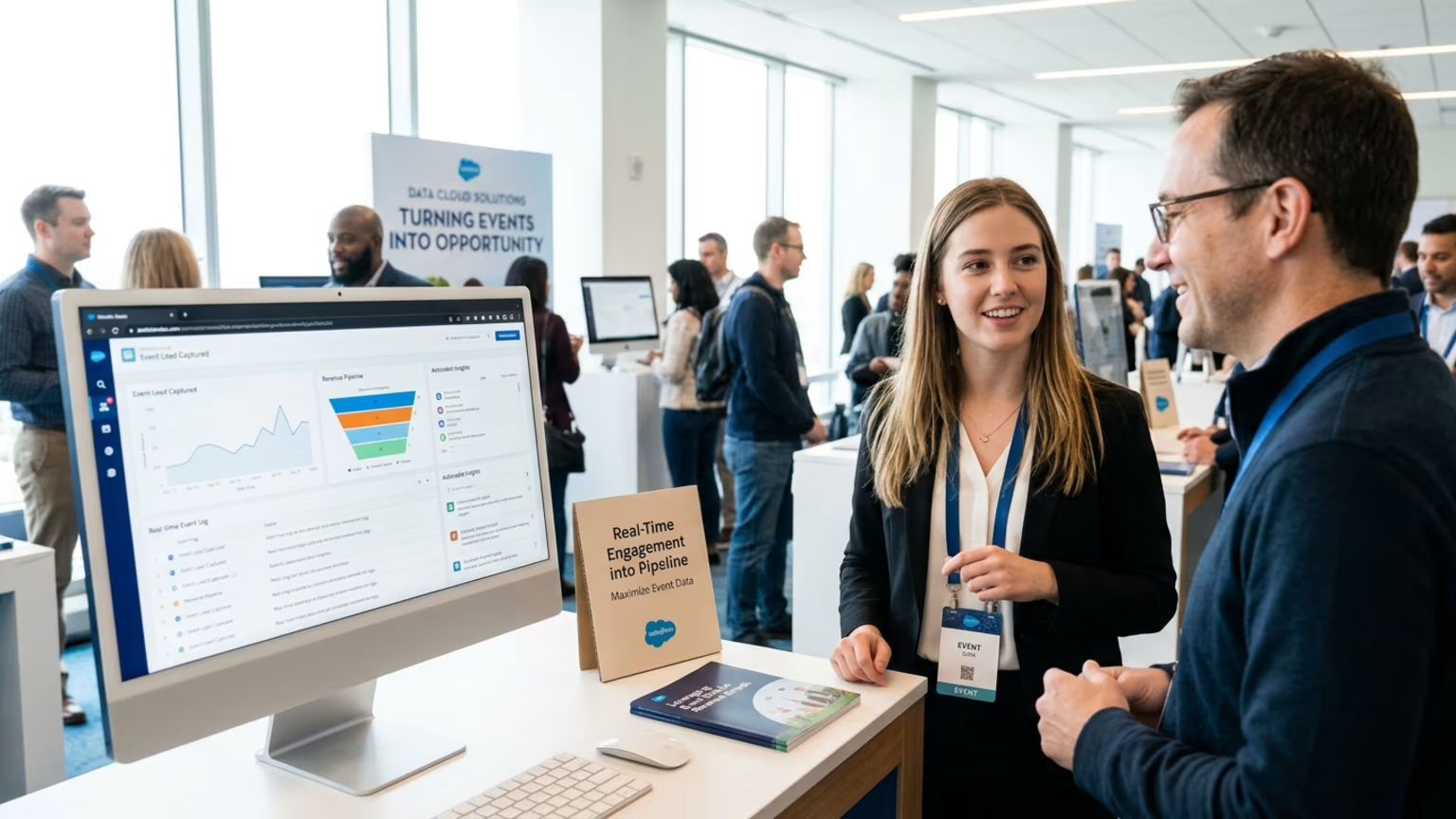
As much as 18 percent of a total B2B marketing budget goes to in-person events. Up to 70 percent of marketing operators struggle to prove their Return on Investment from these activations. This massive spend often disappears into a black box of unorganized badge scans and delayed spreadsheets.
Salesforce recently added real-time event lead capture capabilities to Data Cloud for Marketing. This update allows experiential teams to instantly route physical booth interactions into their unified sales pipeline for clear attribution.
The trade show floor is a high-stakes environment where attention is scarce. Your team spends months designing the perfect booth experience for a major product launch. Attendees finally arrive, sample your product, and scan a QR code. Then the momentum stops completely.
Event data usually lives in a disconnected application for days or weeks. When the leads finally reach your customer relationship management system, they lack context. Sales representatives see a list of names without any insight into what the person did at the booth. The leads grow cold, the pipeline stalls, and proving the financial impact becomes impossible.
A Field Marketing Director faces immense pressure during a national retail expansion or a critical expo presence. The entire company expects these physical activations to drive retail sell-through and boost retailer confidence. Yet the reporting tools often fail to capture the reality of the floor. Marketing operations blames the field team for capturing incomplete contact records. Both groups end up frustrated by the lack of clear performance data.
Managing a national Costco roadshow or a mobile sampling tour multiplies these reporting challenges. Teams are operating across dozens of markets simultaneously, interacting with thousands of shoppers. Without a centralized digital capture method, regional managers are left consolidating paper forms and disparate spreadsheets. This manual consolidation process guarantees that valuable consumer data will be lost or corrupted.
Physical activations generate hundreds of micro-signals per attendee. Visitors might test a product, watch a digital presentation, or chat with a product specialist. These actions represent massive buying intent in the real world. Without a unified system, those actions evaporate the moment the attendee walks away.
Salesforce is closing this gap with new capabilities for Data Cloud for Marketing. The platform now ingests in-person and hybrid event signals directly into its unified profile stack. Marketers can capture event interactions instantly instead of relying on batch uploads. This shift connects physical floor engagements directly to digital reporting tools.
Every badge scan, product demonstration, and session check-in becomes structured data. The system automatically de-duplicates these event contacts and matches them with existing records. According to recent financial reports from Salesforce, real-time data integration builds trust and transparency with stakeholders. This integration means experiential teams can score, route, and measure physical leads exactly like digital ones.
This strategy aligns perfectly with AI-powered tools for universal lead capture that bridge the physical and digital divide. Brands that integrate real-time reporting tools for event data gain a massive advantage over competitors. They can identify trends, monitor performance, and adapt their floor strategy within minutes.
Identity resolution is the engine powering this change. A visitor might use a personal email to register for a trade show. They might use a work email to request a follow-up meeting later. Data Cloud connects these separate touchpoints into a single, unified profile.
Customers move fluidly between physical and digital spaces every single day. A buyer might taste a new beverage at a retail demonstration, scan a code to view ingredients, and later buy via Instacart. The modern marketing technology stack must treat this as one continuous sequence rather than three disconnected touchpoints.
Digital transformation value erodes quickly after launch if organizations fail to manage integration monitoring. A platform like Data Cloud requires continuous governance to maintain its effectiveness. Experiential teams must treat event lead capture as a continuous pipeline rather than a one-time setup. Ignoring this ongoing maintenance guarantees that your real-time data will eventually become just as messy as your old spreadsheets.
This unified profile allows artificial intelligence to recommend the next best action for your sales team. Representatives know exactly which prospects to call first based on booth behavior. They know which specific offers to present based on the physical activation.
You need a precise plan to integrate this technology on the show floor. Real-time data requires preparation, operational discipline, and clear alignment with your sales team. Follow these direct steps to capture better signals at your next activation.
Map every physical interaction to a specific data point. Define exactly what happens when a visitor taps an NFC tag or scans a badge. Verify your sampling application tags the exact product variant and sales representative involved. Every action must map perfectly to a Data Cloud field.
Standardize your campaign hierarchies before the doors open. Tag all event-sourced activities to specific child campaigns for accurate attribution. This prevents bad data from ruining your post-event reports. Bad data often leads to wider tracking failures, much like how poor CRM data undermines AI lead scoring.
Establish strict rules for identity resolution. Decide whether to match records by email, phone number, or company name. Train your brand ambassadors to ask for work emails to improve account association rates. Quality data capture requires active training and constant oversight from management.
Train your field and experiential teams on data-first execution protocols. Before every big show, align your staff on what exact data matters most to the organization. Explain to your staffing partners that their performance includes data quality, not just friendly interactions. A well-trained brand ambassador is your strongest asset for securing accurate customer information.
Enforce instant data syncing from the floor. Replace manual spreadsheet exports with active API connections from your capture tools. Design your workflow assuming every interaction appears in Salesforce within minutes. Real-time data pipelines are an absolute requirement for immediate segmentation.
Set firm service level agreements for sales follow-up. Require your sales team to contact premium prospects within 24 hours. Place lower-tier contacts into automated nurture sequences based on their booth behavior. Speed is the absolute most critical factor in event follow-up success.
Proving the value of a physical activation requires concrete numbers. You must shift away from vanity metrics like foot traffic and total badge scans. As capital costs rise, executives heavily scrutinize expensive marketing line items. The new Salesforce features allow you to track the exact metrics that matter.
Start by tracking the total number of net new accounts created during the show. Monitor your lead conversion rate uplift compared to previous manual import methods. Implementation experts note that improved forecast accuracy and faster sales cycles are key markers of success. These early indicators show that your team is capturing high-intent prospects.
Lagging indicators provide the final proof of your event strategy. Measure the total pipeline value generated by the specific event campaign. Track closed-won revenue tied directly to the initial booth interaction. This data allows you to prove the financial worth of your field marketing program.
For consumer brands, correlate event timing with point-of-sale data to measure retail sell-through. You can track how Kroger Precision Marketing uses retail media and activation data to drive massive brand growth. Connect the timing of your activation directly to wholesale order data at key retailers.
Board members no longer accept anecdotal evidence of a successful marketing event. They demand to see how the cost of building a booth translates into long-term customer value. By unifying your offline signals into Data Cloud, you can generate reports that speak the language of finance. You can finally prove that an expensive sponsorship activation was a mathematically sound business decision.
You can even evaluate key metrics for field pop-up activations to refine future experiential budgets. Compare which events deliver the highest quality prospects over a twelve-month cycle. Reallocate your budget toward activations that produce verifiable revenue rather than mere foot traffic.
Consumer packaged goods brands require flawless execution to stand out in crowded retail environments. Our team creates in-store experiences that leave a lasting impression on consumers. We focus on connecting the physical tasting experience directly to measurable sales outcomes.
A Director of Brand Strategy in the CPG snack division shared: "The Makai team turned our product launch into a sensory event that shoppers still talk about. From creative storytelling to flawless in-store execution, they made snack time unforgettable. We couldn't have asked for a stronger partner." Our team created an in-store experience that left a lasting impression on consumers and became a memorable brand moment.
This level of engagement provides the perfect environment for capturing structured data. When consumers sample a new beverage, we guide them toward a digital touchpoint. They might scan a code to enter a giveaway, join a loyalty program, or claim a retail discount. Those digital signals feed instantly into a unified profile.
You can then trigger automated follow-up messages when the product is still fresh in their minds. A consumer might receive a coupon text exactly ten minutes after trying a new protein bar. This immediate loop connects the physical trial directly to a verified digital purchase.
If you want to integrate this level of precision into your next campaign, you need an experienced partner. We can help you align your field operations with your digital reporting goals. Book a strategy call to start planning your next high-converting brand activation.
The trade show floor will always be a loud, high-stress environment. The difference now is that the chaos no longer extends into your reporting systems. With real-time lead capture, those brief booth conversations transform instantly into visible pipeline revenue. You are no longer guessing about the impact of your event marketing budget.

30 Years Experiential & Retail Activation Partner for CPG & Beverage Brands | Multi-Market Demos, Roadshows & Costco/Club Programs That Actually Sell