Robbie Thain
Founder, CEO

Train field teams on compliance to protect your brand and drive measurable pipeline. Learn frameworks for product claims, role play, and retail demonstrations.

Training a field team on compliance is not about creating a legal roadblock. Compliance training for brand ambassadors is the operational discipline of protecting a brand while simultaneously driving qualified pipeline. Most programs treat this as a mandatory presentation before returning to vanity metrics. In reality, effective compliance training equips a team to diagnose consumer needs, create a useful product experience, and respond accurately without making illegal claims. It shifts the focus from simple awareness to measurable commercial outcomes.
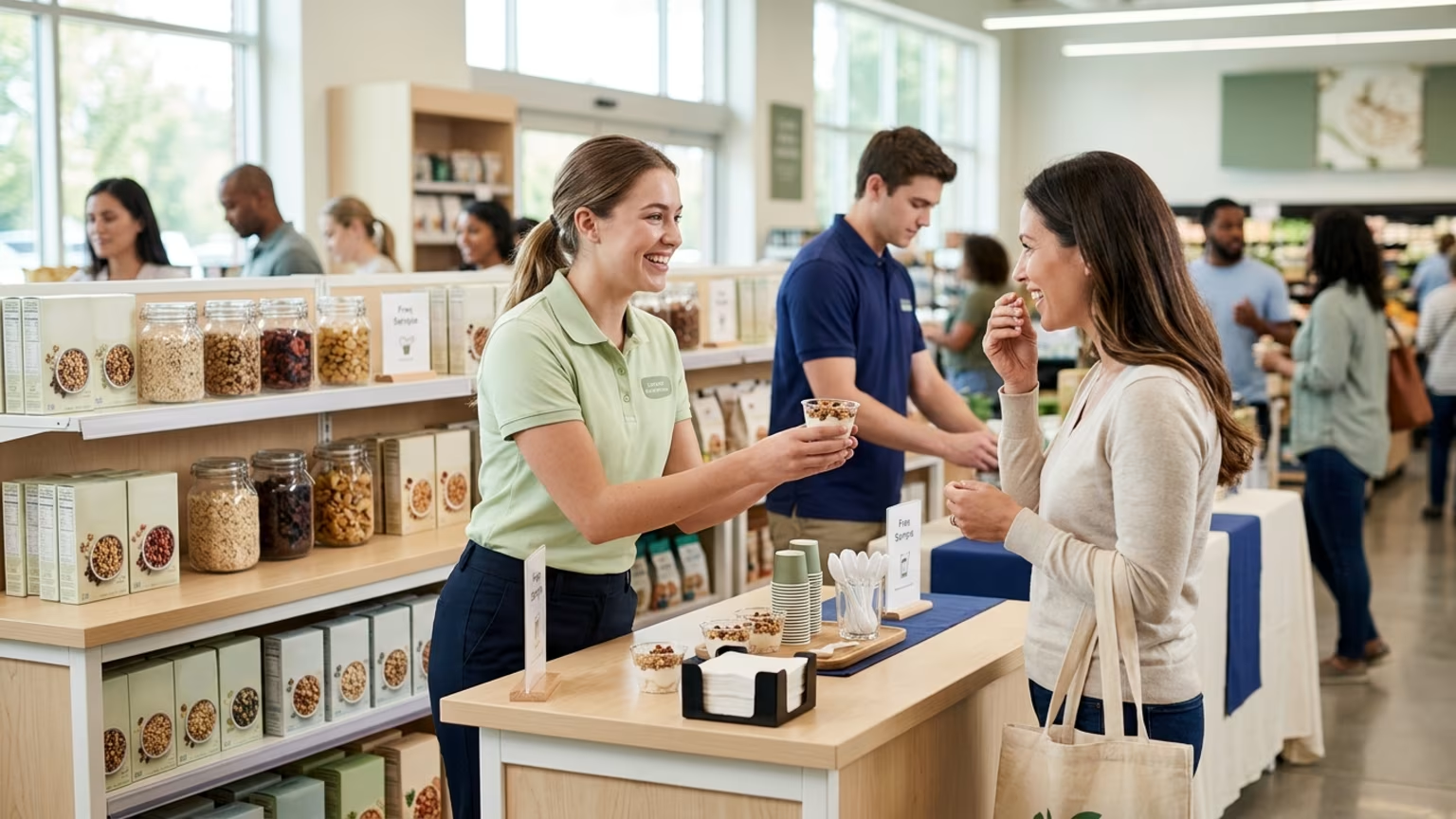
In the physical world of consumer packaged goods, abstract guidelines must translate into concrete behaviors on the retail floor. A field team cannot be trained merely to recite a brand brief. American Guerrilla Marketing describes brand-specific ambassador training covering several core topics. These include product knowledge, consumer approach, objection handling, and conversion prompts. The curriculum also details data collection and field documentation. These elements ensure that representatives handle real shopper questions without overstepping regulatory boundaries.
We have executed over 1000 campaigns across all 50 states, bringing brands to life in every major U.S. market. From retail demos in Seattle to roadshows in Miami and events in Honolulu, our teams activate brands wherever our clients' audiences are located.
Through this volume, we see firsthand that abstract brand messaging fails when it meets a hurried shopper. Representatives must know exactly which claims are approved and which require escalation. BeanCount notes a specific requirement for food and supplement programs. Training modules must include ingredients relevant to consumers alongside the regulatory language required for applicable claims.
Training should begin with the business outcome rather than a generic script. The team needs to know whether the assignment is primarily designed to drive product trial, generate qualified leads, or collect consumer feedback. Avoid giving staff a long list of equal priority talking points. Instead, give them one central objective, three or four proof points, and a clear next action.
Building a high-performing and compliant field program requires three primary components. Brands must establish a rigid product knowledge system that categorizes approved claims. For products requiring physical preparation, American Guerrilla Marketing notes that training must cover equipment, preparation time, and waste management. It should also address product quality and how to maintain interaction flow.
Representatives must separate actual brand promises from personal opinions. You need a structured approach to train field brand ambassadors for retail conversions without risking unapproved health or performance claims.
Second, teams must master a structured demonstration technique through extensive role play. Evolve Activation recommends structuring product demonstrations around Scenario, Comparison, and Outcome. This framework introduces the consumer's problem first before positioning the product as a solution. Evolve Activation advises facilitators to ask open-ended questions, listen actively, and adapt the demonstration to the visitor's needs.
As an operating guideline, Evolve Activation recommends 60 to 90 second loops during peak traffic and 90 to 180 second conversations when traffic allows.
Third, programs require relentless field reinforcement and rigorous data hygiene. A one-time briefing will not prevent compliance drift during a multi-city tour. American Guerrilla Marketing describes written and live briefings, pre-deployment clearance, supervisor check-ins, and ongoing monitoring as necessary field management practices.
If a digital screen or application fails, Evolve Activation notes that a cue-card demonstration or verbal walkthrough can keep the interaction moving. When brands invest in training field staff for consistent brand experiences that convert, they build resilience against inevitable live environment glitches.
Role play is where memorized talking points become actual field capability. A standard written test cannot prepare a representative for a live retail environment. Demonstration training recommendations include practicing different visitor personas before an event begins. Evolve Activation recommends role playing visitor personas, objections, technology glitches, and adaptive conversations before an event.
Each staff member should complete multiple scenario rounds. They must practice a fast pass where they engage a consumer and deliver the core experience quickly. They must also identify whether the consumer is a trial participant, a buyer, or a low intent visitor. Score each role play on product accuracy, approach, and compliance.
Objection handling should never mean arguing with consumers. The goal is to acknowledge the concern, clarify it, and respond with an approved proof point. Representatives must offer a low pressure next step like a trial, comparison, or respectful exit. Create specific scenarios for price concerns, ingredient questions, or competitive brand loyalty.
For health and supplement activations, the response library must be strictly managed. Representatives must clearly distinguish approved product claims from opinions, medical advice, or unsupported promises. A team member who memorizes ten features but cannot determine which one matters to a shopper is not ready for live engagement. The field source specifically notes the need for regulatory language around food or supplement claims.
Deploying this operational framework requires a deliberate rollout schedule. During the first week, managers must define the primary business objective and identify priority audiences. They should build the product, claims, and escalation libraries prior to drafting any scripts. This initial phase ensures that interaction and lead standards are firmly established.
The subsequent weeks focus on building the materials and certifying the staff. Managers must write the training guide, create demonstration cue cards, and prepare role play scorecards. Once materials are ready, leaders run live product training and rehearse the demonstration under timed conditions. They must score each staff member and remediate anyone who fails a critical compliance standard.
Deployment and improvement happen continuously in the final phase. Supervisors conduct pre-shift huddles, observe live interactions, and review data quality daily. They compare locations, time windows, and interaction outcomes to spot trends. The management team updates the training system using real consumer questions and objections captured during the shifts.
The true test of any compliance and training program is how it translates into measurable field data. A crowded activation might look impressive, but it is commercially weak if staff cannot document a meaningful next step. American Guerrilla Marketing lists samples distributed, interactions logged, purchase observations where applicable, and location performance among sampling reporting measures. The source also includes consumer feedback within these tracking frameworks.
This operational rigor provides marketing leaders with a clear view of location efficiency and team execution quality. Accurate reporting demands that representatives record interactions consistently and avoid estimating missing information. Evolve Activation recommends integrating QR codes, badge scans, or live polls into the experience when the capture request is useful and timely. However, any technology involving personal data requires strict privacy adherence.
Evolve Activation mentions RFID and facial recognition only with explicit consent. Furthermore, sales lift analysis should be presented cautiously because its availability depends on retail data access. The cited American Guerrilla Marketing source does not specify a control group methodology for these metrics.
The bottom line is that compliant ambassador training transforms abstract legal guidelines into observable field behaviors that secure Return on Investment and safeguard the brand.
When a field team internalizes the boundaries of their brand, they stop worrying about what they cannot say and start focusing entirely on the person standing in front of them. The interaction becomes a genuine exchange, anchored by trust and sustained by operational discipline.
Converting compliant ambassador training into measurable retail pipeline requires flawless backend execution. Makai eliminates inefficient post event follow up and CRM routing by assuming total operational control. We deploy our Storage & Logistics capability to store your sampling product and event gear, then ship, track, and coordinate delivery nationwide so every activation stays on schedule.

30 Years Experiential & Retail Activation Partner for CPG & Beverage Brands | Multi-Market Demos, Roadshows & Costco/Club Programs That Actually Sell