Robbie Thain
Founder, CEO

Turn BevNET beverage trends into measurable experiential activations. Learn how CPG brands use data to optimize live sampling and drive retail sales.
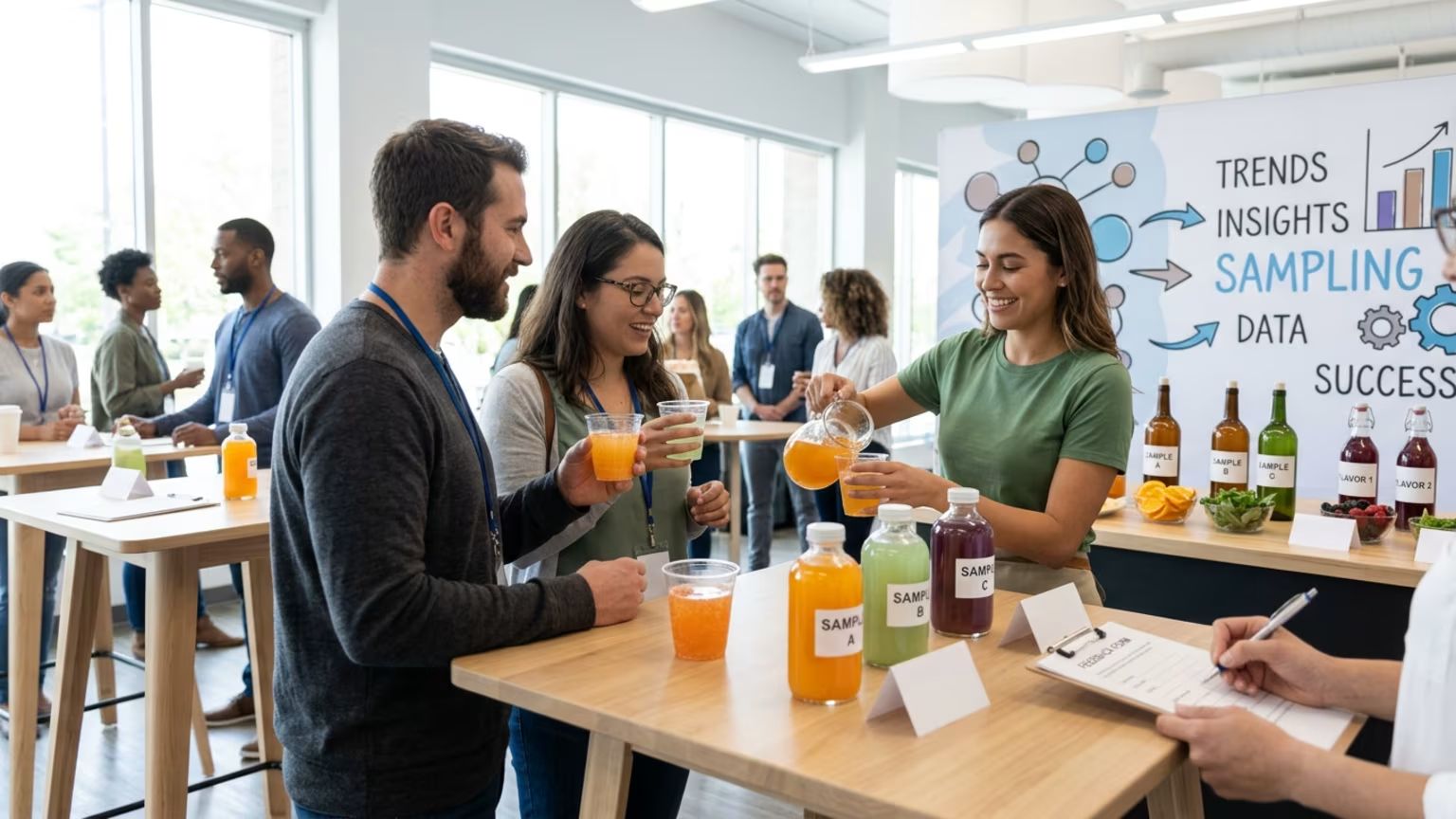
Most beverage brands waste their field marketing budget trying to manufacture consumer demand out of thin air. Instead of guessing what shoppers want, smart operators use emerging category trends to position their products precisely where existing demand already lives. Recent industry gatherings reveal clear signals around ready-to-drink growth and shifting consumer preferences. This article outlines a method to turn those high-level category insights into measurable field activations that drive trial and capture market share.
You read the latest industry reports. The data clearly shows that premium ready-to-drink cocktails and functional waters are surging in popularity. You stock the trade show booth, brief the brand ambassadors, and wait for the magic to happen. Within two hours, the booth is swamped with freebie hunters.
The core brand messaging gets totally lost in the noise. Your team is frantically pouring samples without capturing a single qualified lead. This chaotic scenario haunts countless experiential campaigns. Companies spend thousands on premium exhibit space and logistics.
They ship pallets of product across the country. They hire local staff to manage the massive crowds. Yet, the interaction quality remains painfully low. The gap between category intelligence and live execution remains incredibly wide for many operators.
Without a disciplined operational strategy, brilliant consumer insights simply evaporate in the busy aisles of a massive convention center. Trade marketing managers face immense pressure to prove that costly physical appearances actually generate retail sell-through. Executives want to see a direct correlation between the sampling budget and the bottom line. When an event looks busy but produces zero actionable data, leadership begins to question the value of the entire experiential channel.
High volume traffic does not automatically equal high value engagement. A crowded booth often creates a false sense of security. Many legacy beverage brands still rely on outdated field marketing playbooks. They send poorly briefed teams into retail stores with a folding table and a branded tablecloth.
The staff simply stands there, handing out plastic cups to anyone who makes eye contact. They do not ask qualifying questions. They do not explain the unique selling proposition. They just burn through inventory as fast as humanly possible.
This antiquated method actively damages brand equity. Shoppers walk away with a free drink but zero emotional connection to the product. The brand gains zero actionable intelligence. This cycle of wasted spend continues quarter after quarter, bleeding marketing budgets dry.
The strategic fix relies on mapping your field marketing directly to validated category data. When industry analysis highlights functional benefits or convenience as primary growth drivers, your sampling footprint must reflect those exact consumer priorities. This framework demands abandoning generic product pitching in favor of targeted interactions. We call this approach data-led physical activation.
It requires building a tight feedback loop between macro industry trends and micro consumer interactions. Brands must translate high-level metrics into ground-level conversation starters. If a report indicates that shoppers care deeply about gut health, your brand ambassadors must lead with that exact point. They should never just hand over a cold can.
They must explain the science behind the formulation before the consumer takes their first sip. When you pair hard data with live product trials, brands that invest in hyper targeted live sampling programs see higher returns. This alignment transforms your event presence from a passive sampling station into an active consumer research hub. Category management teams can use this real-world feedback to refine their national retail strategy.
They gather direct objections, flavor preferences, and pricing feedback directly from the target demographic. Retailers are increasingly looking for smart category planning strategies that prove a product deserves premium shelf space. Your field marketing data becomes the hard proof they need. A true data-led physical activation turns the trade show booth into a live testing laboratory.
Modern consumer packaged goods companies cannot afford to guess what the market wants. They need hard proof before committing to massive retail distribution deals. Your experiential footprint must be designed to validate the exact trends highlighted in recent industry reports. If the data points toward a massive spike in non-alcoholic adult beverages, your activation must measure consumer reaction to complex flavor profiles.
You must track how shoppers respond to premium pricing models in real time. Achieving this level of precision requires advanced audience targeting long before the event begins. Recent industry publications highlight new technological systems built for exact consumer segmentation. According to C-Store Dive, modern audience targeting platforms use agentic AI frameworks to reach defined shopper demographics with unprecedented accuracy.
You must apply this same level of targeted discipline to your physical event invitations and booth location strategy. Pre-qualifying your foot traffic eliminates wasted product sampling on site.
Knowing the trends is only half the battle. You must translate consumer insights into physical movements on the event floor. A structured protocol prevents the chaos of the trade show from overwhelming your brand message. Here is a clear method to operationalize category findings into a high-converting experiential campaign.
A systematic approach eliminates the guesswork from field marketing. It forces your team to treat every single sample as a tiny business transaction. The consumer gives you their attention and data, and you give them a premium brand experience. If you are struggling to build this kind of structured event presence internally, you can easily book a strategy call with our team to map out a precise action plan.
Experiential marketing demands rigorous measurement to justify the immense capital expense. We must track targeted lead and lag metrics to secure a clear Return on Investment for every single activation. Vanity metrics like total booth visits offer very little actual business value. True operational success requires tracking the behaviors that indicate actual future purchases.
Lead metrics tell you if your live activation is functioning correctly in real time. Track the qualified conversation rate daily. This number measures the percentage of visitors who engage in a full product discussion. It reveals if your ambassadors are truly connecting with the audience or just handing out free drinks.
Monitor your sample-to-survey conversion rate closely throughout the day. This metric shows how many people are willing to trade their contact information for a trial. A high conversion rate indicates that your value proposition is highly compelling. Evaluate ambassador adherence to track if your field team is delivering the approved brand messaging consistently.
Many brands mistakenly celebrate high booth traffic without measuring actual dwell time. Dwell time tracks how many minutes a potential buyer spends interacting with your brand assets. A visitor who stays for five minutes to discuss ingredients is infinitely more valuable than ten people grabbing a can and walking away. Advanced camera systems and digital footprint tracking can now measure this engagement duration accurately.
Lag metrics prove the long-term financial viability of your experiential efforts. You must measure retail sales lift in the precise geographical region surrounding your activation. Compare the sales data from the four weeks following the event against your historical baseline. This calculation requires close partnership with your retail distribution partners.
Track customer acquisition cost by dividing your total event spend by the number of verified retail purchases. Monitor the repeat purchase rate of customers acquired during the live event. This data gauges the true lifetime value of those experiential leads. By tracking these figures, you can confidently determine how physical interactions impact retail sell-through over the long term.
Consider the launch of a new functional beverage targeting health-conscious professionals. The brand saw industry data indicating a massive shift toward cognitive health claims in the ready-to-drink space. Instead of a generic tasting tour, they built a highly structured activation inside premium corporate parks. They matched their physical locations directly to the demographic data found in recent consumer reports.
Their field teams received intensive training to discuss defined mental clarity benefits rather than just refreshing taste. The brand required consumers to complete a brief digital survey about their daily energy slumps before receiving a full-size sample. This slight friction point eliminated freebie hunters entirely. It guaranteed that only highly qualified prospects received the premium product.
A VP of Marketing in the CPG beverage category told us: 'Robbie, your leadership and vision turned our campaign into something truly special. The Makai team brought our new drink to life with energy, creativity, and flawless execution. Thanks to you, our brand isn't just tasted, it's remembered.' Our team's approach transformed their product launch into a memorable brand experience.
This precision-driven model produced a measurable spike in regional retail distribution within six short weeks. The data gathered from the field proved to retail buyers that consumer demand was real, active, and ready to convert. When you align high-level category intelligence with flawless ground execution, the financial results naturally follow.
This targeted strategy dramatically reduced their overall product waste. They distributed fewer total samples than their competitors at nearby trade shows. Yet, their post-event conversion rates broke company records. They traded meaningless volume for high-impact interactions, proving that precision sampling always beats mass distribution.
The noise of a crowded expo floor can easily drown out a great product. Yet, when category data and disciplined execution finally intersect, the chaos fades into perfect clarity. A single perfect sip, served with intent, holds the power to shape retail history.

30 Years Experiential & Retail Activation Partner for CPG & Beverage Brands | Multi-Market Demos, Roadshows & Costco/Club Programs That Actually Sell


