Robbie Thain
Founder, CEO

What Outcomes Rocket's survey says about event reporting confidence, plus Makai's perspective on lead ownership, staffing and follow-up.

On October 15, 2026, Outcomes Rocket announced findings from its 2026 State of B2B Event Marketing: From Attendance to Commercial Motion report. In its September 2026 global survey of 841 marketing, sales and business-development professionals, 68.9% said they had given leadership an event Return on Investment (ROI) figure they were not confident in.
That finding puts a specific problem on the table: confidence in the number presented to leadership. For field-marketing leaders, the useful response is to examine the work behind that number before asking for a cleaner report.
Outcomes Rocket says the survey was administered through Prolific and reported in aggregate. Alongside the confidence finding, its release identifies gaps in source tracking and pipeline ownership:
These are self-reported findings from one global B2B survey, not a U.S. CPG or consumer-sampling benchmark. The release provides no detailed respondent profile or full questionnaire and does not validate the accuracy of submitted ROI figures. It also does not quantify the revenue effect of individual process gaps or establish that a particular fix improves returns. Its framing is particularly directed at medtech and healthtech event teams.
The operational question is narrower than whether events work. It is whether teams have defined the objectives and responsibilities needed to explain what happened after people showed up.
Our reaction at Makai is straightforward: keep the welcome generous and the handoff precise. A spontaneous conversation can be the point of a live experience. We believe the planning failure comes when nobody has decided what a meaningful interaction looks like or who owns its next step.
We have connected brands with people through live experiences, retail programs and national activations since 1995. For CPG and beverage brands, our position is that trial and commercial follow-through deserve attention together. A consumer tasting and a retailer conversation can both matter without belonging in the same reporting category.
We provide reporting on reach, trials, leads and sales to guide campaign optimization. Our measurement approach tracks awareness, engagement and conversion. The value is not simply having more fields in a report. It is preserving the distinctions between exposure and participation, then showing where commercial outcomes fit.
By 2009, our work covered sponsorship activation and mobile tours alongside sampling and national event logistics. Makai's inclusion in the 2009 PROMO 100 reflected that breadth. The lesson we draw from it is about coordination: different activation formats need a shared understanding of the objective without forcing every interaction into one definition of success.
That is the lens we bring to evaluating captured pipeline rather than attendance alone. The report should explain the experience's purpose rather than flatten every activity into a lead count.
In separate coverage, Event Marketer describes George P. Johnson's approach to aligning stakeholders on objectives and selecting KPIs before an event. Data-capture planning is also part of that process.
For Makai, that is a useful practitioner principle: measurement belongs in the operating brief. Applied to the gaps Outcomes Rocket reports, the next decisions concern staffing responsibilities and the path from conversation to follow-up.
In our view, a staffing brief should explain what qualifies as a useful lead and who owns it after capture. A team tasked with welcoming visitors needs that context just as much as the person responsible for the eventual CRM record. Otherwise, the activation objective and the reporting definition can remain separate conversations.
The goal is not to turn every brand ambassador into a salesperson. Our retail demonstrations use trained ambassadors to support sales through product trials and real conversations. For a campaign with a pipeline objective, the brief should distinguish that shopper interaction from a qualified buyer discussion.
A review of the activation's operating details is a practical place to connect staffing expectations with lead ownership. The question behind that review is simple: whether the team understands what information must travel with a valuable conversation.
Makai plans and manages trade show spaces designed to attract attention and start conversations that can become customer relationships. Our view is that the footprint should reflect those priorities. A space intended for product trial should not be evaluated exactly like one intended for qualified retailer meetings.
The survey's finding about unplanned conversations is not a reason to script every exchange. We see it as a reason to plan how useful conversations are recognized and connected to follow-up. Leave room for human curiosity while making responsibility clear.
This changes the planning discussion from how many people can pass through the space to what the team needs to learn from their participation. For a beverage activation, trial can remain a valid objective. For a trade show focused on buyer relationships, the relevant evidence may instead be qualified conversations and their progression into pipeline.
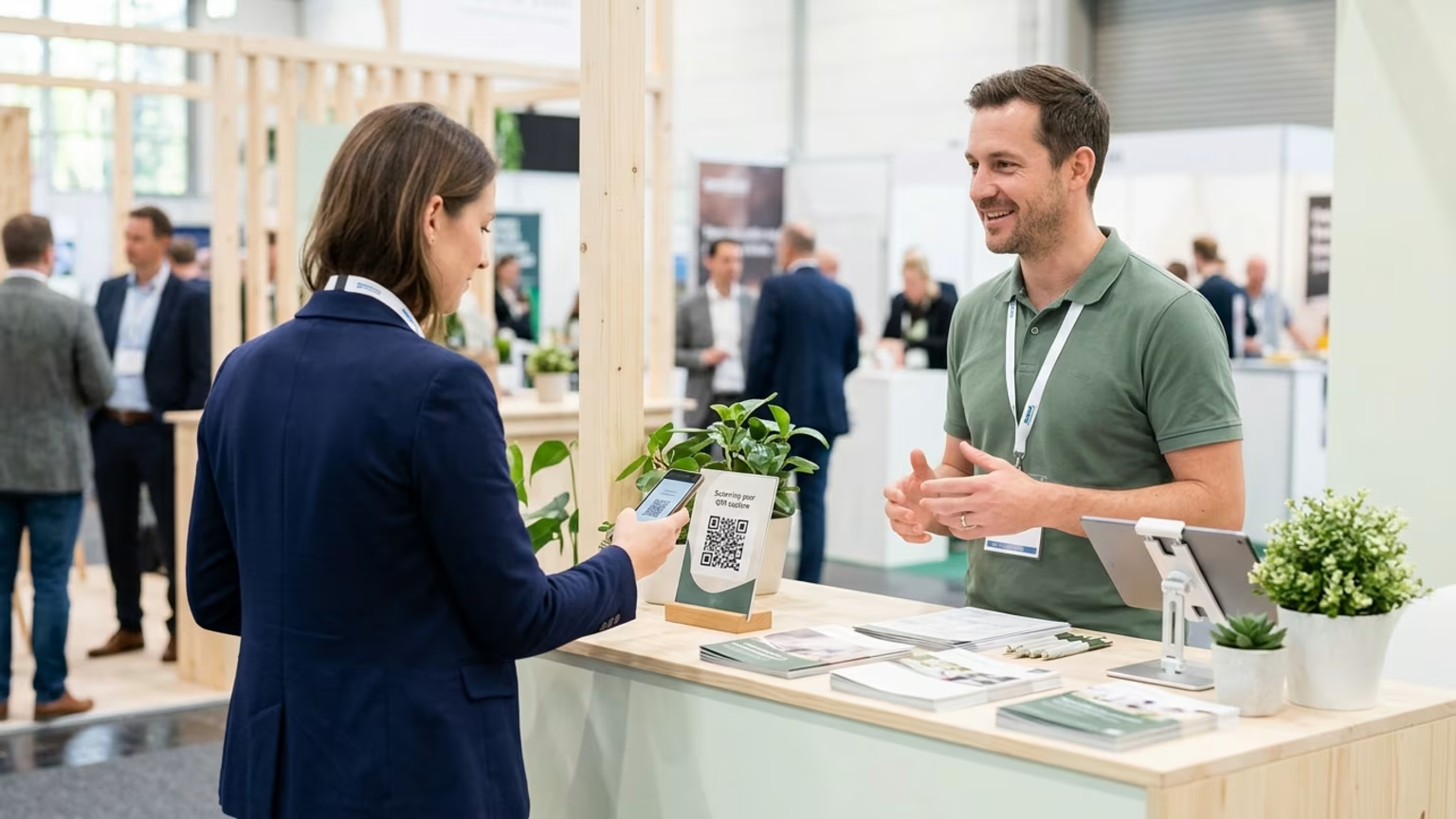
We integrate QR codes and mobile technology across retail, event and tour experiences. These tools connect physical participation with a digital layer. In our view, that connection should support the campaign objective rather than become another activity counted without context.
The practical priorities supported by the research are clear: assign an owner and define a qualified lead. Connect event-source information to the follow-up process. Those decisions give the capture method a purpose beyond collecting a record.
Ownership also needs to remain visible after the event. A useful post-event operational review can examine whether source information reached the follow-up process and whether responsibility stayed clear. The point is not to demand that every conversation produce revenue. It is to distinguish a documented outcome from an assumption.
For us, the useful operational change is agreement before execution. The field team should understand the same objective that leadership will later use to assess the event. That agreement gives a spontaneous exchange somewhere to go without pretending that every visitor has the same intent.
Outcomes Rocket CEO and Founder Saul Marquez stated his position directly in the release:
> “A conference is not a marketing expense. It is a revenue event, and it should be run like one.”
That is an executive's operating philosophy. Makai's position is that commercial ambition should shape the planning brief without erasing other legitimate objectives. Awareness and product trial still deserve accurate measurement when they are the purpose of an activation.
Calling an event a revenue opportunity raises the standard for explaining its contribution. For us, the discipline is keeping the objective and the evidence connected through a clearly owned follow-up process.
For a CMO or VP of Marketing, the next planning cycle offers a chance to settle definitions before execution begins. The priorities are the ones this research brings into view: a clear objective and a qualified-lead definition. Event-source tracking and follow-up ownership belong beside them.
Our view is that a defensible report begins with those agreements. A useful conversation should remain recognizable after the visitor has left and the activation has closed.
When your next event report reaches leadership, will you be able to trace its commercial claims back to conversations someone clearly owned?
Consumer events pair live interaction with a later follow-up challenge; Makai designs experiences that bring brands and people together through emotion and engagement. For CPG marketers dealing with inefficient follow-up and CRM routing, Makai's experiential campaigns and trade show activations focus on turning brief consumer interactions into qualified leads.

30 Years Experiential & Retail Activation Partner for CPG & Beverage Brands | Multi-Market Demos, Roadshows & Costco/Club Programs That Actually Sell