Robbie Thain
Founder, CEO

Industry leaders demand next-gen data reporting for experiential marketing. Learn how to tie trade shows and live activations directly to pipeline and ROI.
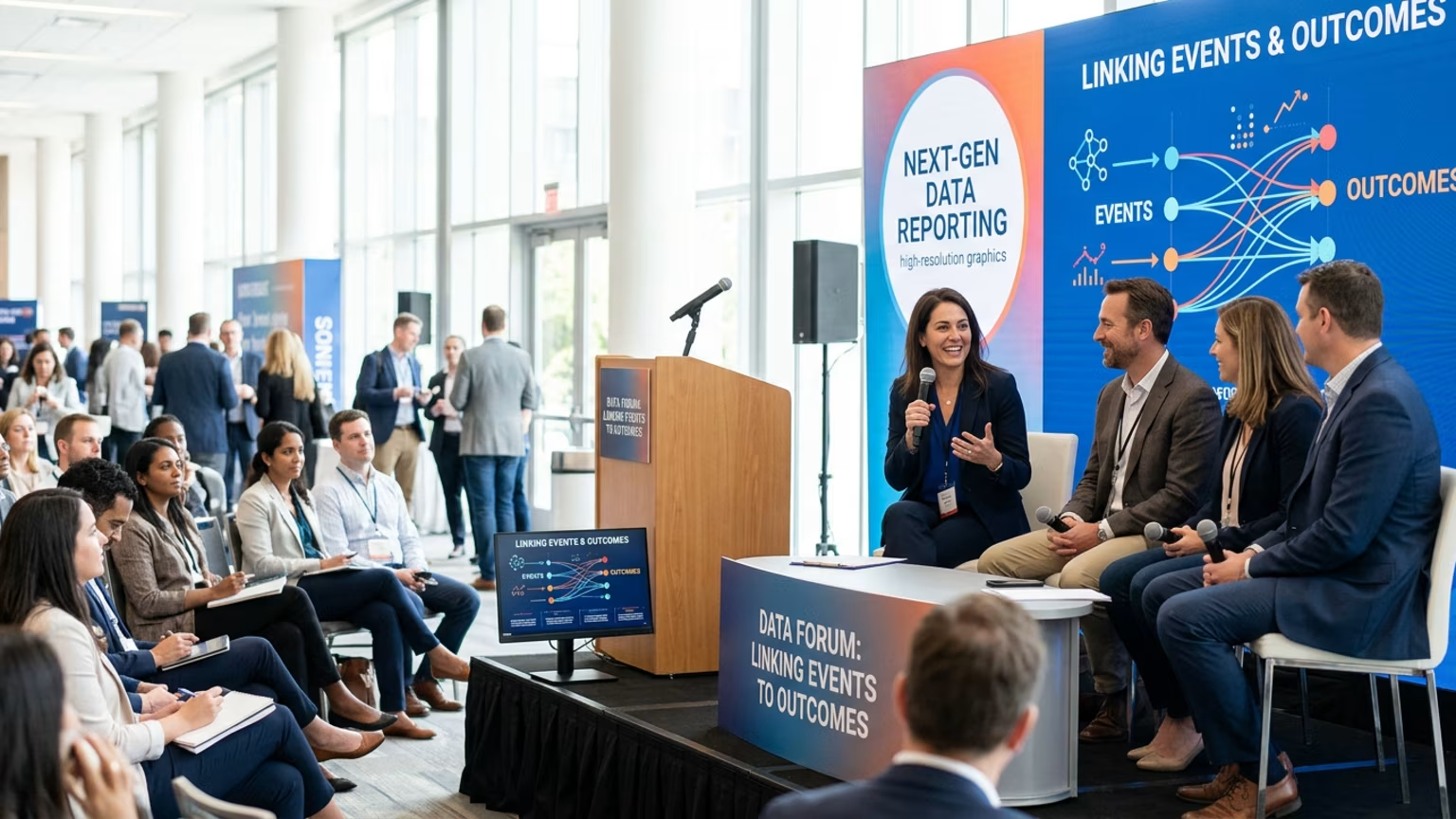
Your experiential events are no longer immune to the strict financial scrutiny applied to digital channels. You must abandon vanity metrics and adopt unified data reporting to prove tangible Return on Investment.
The doors open at eight in the morning at the national retail expo. Your brand ambassadors pass out premium snack samples to a massive crowd. People are smiling, taking photos, and scanning digital codes for a free giveaway. The booth is packed with eager faces and loud conversations.
Fast forward to next Monday in the executive boardroom. The Chief Financial Officer asks how that expensive footprint generated actual sales. You hand over a printed document filled with estimated impressions and total badge scans. The heavy silence in the room tells you everything you need to know.
The reality is that field marketing operates in an environment of constant logistical friction. Bad weather, delayed freight, and inconsistent staffing can distract you from your primary commercial goals. Teams get so caught up in the physical execution that they forget to capture meaningful business data. The end result is a beautiful brand experience that leaves zero trace in the corporate revenue pipeline.
This outdated approach creates a massive vulnerability for modern marketing teams. When budget cuts arrive, undocumented brand awareness is the very first item slashed. You can no longer rely on anecdotal success stories to defend your physical activations. You need hard math to justify your existence on the trade show floor.
The modern marketing organization operates on strict performance data. Experiential teams must adopt this exact standard to protect their budgets. According to a recent Salesforce report, nearly eighty percent of marketing organizations lead customer experience initiatives. The teams that succeed connect data from multiple sources into a unified customer view [1].
Next-generation reporting requires tying every roadshow directly to pipeline and profit metrics. Keith Turco, CEO of Madison Logic, notes that marketers face growing pressure to connect every tactic to measurable business impact [2]. Artificial intelligence accelerates campaign execution today. The true differentiator remains high-quality data validated by sharp human judgment [2].
In our experience, a physical event must function as a measurable pipeline engine. We create experiential marketing programs built to connect emotion with action. Our process blends creativity, strategy, and data to guarantee every brand interaction drives measurable results. We craft experiences that engage all five senses. We help people not just see brands, but feel them. This turns fleeting moments into meaningful business outcomes.
You must measure Return on Investment accurately. The key is establishing a clean data reporting framework before the booths are ever built. This allows you to track program effectiveness over months. If your current data feels disconnected, book a strategy call with our operations team today.
Brands are expected to engage in real-time, interactive experiences [1]. This validates budgets for in-person activations. This raises the bar for measuring what that two-way engagement delivers in terms of sales. Your reporting needs to plug into that unified view, rather than standing alone as a simple recap document.
To build this internal confidence, you must communicate differently with corporate executives. Stop framing recaps in terms of impressions, reach, or total engagements. Translate your experiential metrics into commercial language like incremental margin, volume lift, and category share. When you speak the language of the boardroom, your budget transforms from an expense into a strategic asset.
Converting trade show chaos into structured data requires strict operational discipline. You need a systematic approach to capture information without ruining the consumer experience. Follow this exact sequence to measure true pipeline.
Centralize your technology stack immediately. Connect your staffing applications, Customer Relationship Management platforms, and Point of Sale systems into one central hub. A Domo guide on marketing reporting emphasizes the need for centralized dashboards and multi-touch attribution models [6]. This technical foundation allows you to track a consumer from their first sample to their final purchase.
Standardize your field reporting taxonomy across all markets. Use consistent tracking fields for event types, audience segments, and specific promotional tactics. This level of uniformity lets you compare a Costco roadshow in California against a pop-up event in New York. You can then allocate your future budget to the most profitable formats.
Mandate strict data entry rules for your field staff. Give brand ambassadors simple mobile tools to log samples and retailer feedback in real time. Poor data entry will destroy your ability to score leads accurately. As noted by industry experts, flawed Customer Relationship Management records will ruin the best analytical models.
Do not assume that artificial intelligence will fix bad data capture. Turco notes that automated systems depend entirely on the quality of the data behind them [2]. If your brand ambassadors submit sloppy spreadsheets, your AI models will simply generate inaccurate forecasts faster. Keep your human operators in charge of selecting the right metrics, designing control tests, and interpreting ambiguous outcomes.
Collaborate directly with your sales department. Define specific time windows for measuring commercial impact by channel. Agree on which internal revenue metrics are trusted by the broader organization. This alignment prevents any future arguments over the validity of your campaign data.
Design your live experiences backwards from the desired commercial outcome. If your goal is to increase Costco velocity for a specific item, structure your roadshow to capture exactly that data. Decide exactly how and when that information will be analyzed before the program launches. This proactive planning transforms a simple tasting event into a structured retail experiment.
Reporting platforms now emphasize clear conversion rates and direct sales impact. Experiential reporting must mirror this exact numerical structure. A Gallagher report on leadership emphasizes setting clear targets reviewed on a quarterly basis [3]. You must define both leading and lagging indicators for your brand activations.
For consumer sampling events, track the total number of qualified leads synced directly to your database. Measure the volume of completed product trials and in-depth educational conversations. These leading indicators tell you if the activation is working in real time. You can adjust your messaging on the fly if engagement numbers drop.
For retail staff training events, focus heavily on post-event knowledge retention. Conduct pre-event and post-event knowledge checks on key product claims. Have regional managers assess the quality of floor execution following the training session. These metrics prove that your educational efforts actually changed human behavior.
Lagging indicators prove the final commercial impact to your leadership team. Track same-store sales lift during and after the activation period. Measure the conversion rate from experiential leads into actual closed revenue. Calculate the repeat purchase rate among shoppers who participated in your live demonstration.
Connecting these distinct numbers gives you a unified performance view. It proves exactly how event attention becomes sales pipeline over a full fiscal quarter. You can show the finance department exactly how much revenue a specific mobile tour generated.
A national beverage brand recently launched a new sparkling water line. The field marketing team deployed a mobile sampling tour across major coastal cities. In the past, they would have only reported the total number of cans distributed to the public. This time, they built a unified data model to track actual retail movement.
The brand ambassadors scanned unique digital coupons at every single stop. The data integrated directly with regional grocery transaction records. The brand measured a fourteen percent velocity lift in activated stores compared to non-activated locations. The CFO finally saw the clear financial value of live consumer sampling.
Another consumer packaged goods company used a similar strategy for a massive retail rollout. They matched their field training schedules with regional sales data. Stores that received dedicated brand ambassador training showed a massive increase in product reorders. The data proved that in-person education directly accelerated wholesale velocity.
These examples highlight the massive financial potential of structured event reporting. Data-driven marketing guidance emphasizes centralizing information from multiple platforms to create a single source of truth [4]. When you tie physical actions to digital records, you unlock a completely new level of operational clarity.
Attribution for physical experiences is inherently complex. A buyer might interact with your booth on Tuesday, receive an email on Thursday, and make a purchase three weeks later. Your next-generation reporting must account for these extended timelines. Combining direct attribution with modeled data provides a highly accurate picture of your true marketing impact.
Over-indexing on short-term conversions can sometimes erode long-term brand equity [4]. Brand building and performance are complementary forces. A pop-up sampling event might not show immediate sales lift, but it drives future preference. Next-generation reporting should include both leading indicators and lagging indicators to capture the full picture.
The gap between physical experiences and digital measurement is closing rapidly. Brands that treat the trade show floor like a high-performance channel will define the next decade of retail success. The data is available for anyone willing to collect it. The real magic happens when you stop counting the crowd and start counting the conversions.

30 Years Experiential & Retail Activation Partner for CPG & Beverage Brands | Multi-Market Demos, Roadshows & Costco/Club Programs That Actually Sell