Robbie Thain
Founder, CEO

Stop losing event leads to poor data handoff. Learn to standardize tagging, automate follow-up, and turn chaotic experiential campaigns into measurable pipeline.
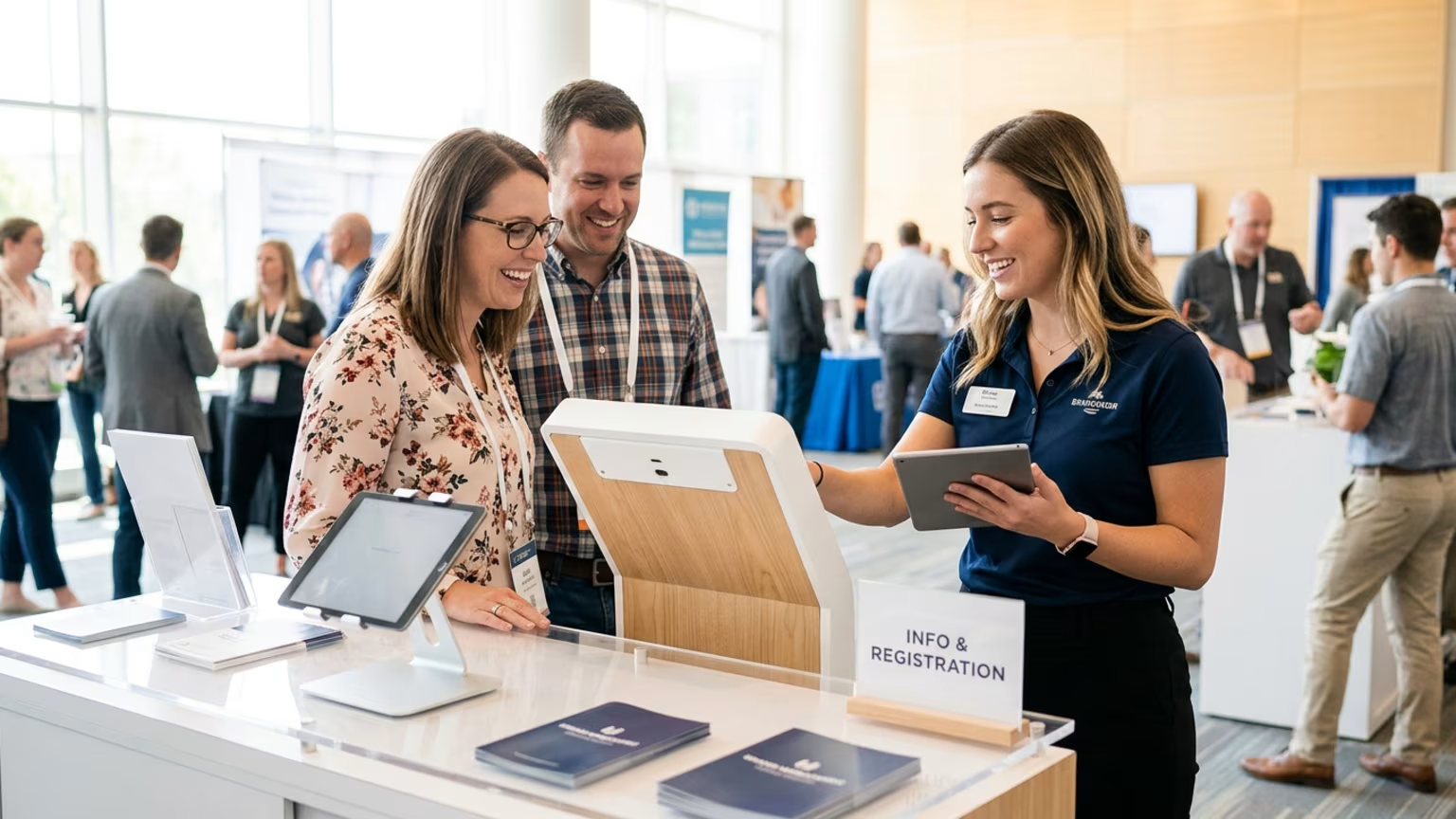
Collecting more leads at your next experiential activation will likely choke your sales pipeline. Amplifying volume without fixing your baseline process magnifies underlying operational dysfunction. This guide outlines how to repair broken data handoffs and weak follow-up protocols so your physical campaigns drive measurable retail sales.
It is hour six of a major national trade show. The music is loud, the booth is packed, and your brand ambassadors are scanning badges relentlessly. Everyone is smiling, high-fiving, and celebrating the massive spike in raw engagement numbers. Field marketing directors face immense pressure to justify their budgets to skeptical executives.
But underneath this energetic surface, a massive failure is quietly unfolding. Your team is pushing every scanned badge into a massive, undifferentiated spreadsheet. A high-intent buyer from a major national retailer is sitting right next to a college student hunting for free snacks. The disconnect between physical excitement and digital pipeline growth destroys credibility fast.
Industry analysts report that 79 percent of marketing leads never convert to sales. The primary culprit is inadequate nurturing and completely fractured follow-up protocols. The excitement on the floor creates a false sense of security for your field team. Marketing operators assume the hard part is over once the badge scanner beeps.
Many organizations assume that once a lead has been captured, the most difficult part of the process is complete. This mindset treats the actual event as the finish line rather than the starting block. When excitement fades without structured guidance, the prospect quickly loses interest. Your failure to maintain momentum wastes the thousands of dollars spent securing the physical space.
The period immediately after the scan is incredibly fragile. Your expensive pop-up activation becomes a beautiful disaster when data handoff processes break down. Sales teams receive a massive list of raw contacts with zero context. They spend hours calling confused attendees who barely remember your product, leading to mutual frustration.
Broad targeting feels safer when you are trying to justify the cost of event square footage. But chasing raw volume sacrifices quality and creates extreme pipeline friction. Poorly defined ideal customer profiles cascade into long sales cycles and high churn rates. The vanity metric of heavy foot traffic masks the complete lack of true market impact.
The traditional method of dumping raw event data into your CRM is fundamentally broken. You need a systematic framework that prioritizes behavioral signals over simple demographics. Every physical interaction must map directly to a structured digital sequence. The goal is to build a system where the transition from physical space to digital CRM is completely invisible.
Research indicates that nurtured leads make 47 percent larger purchases than ignored prospects. To capture this value, your experiential strategy must treat lead capture as a unified system. Awareness, engagement, and post-event nurture must operate as a single, continuous funnel. Modern marketing requires an operator mindset that views experiential touchpoints as data collection nodes.
Analytics tools are gaining massive traction in the market for surfacing high-intent signals. They address inconsistent tagging by tracking exact engagement levels during real-world events. Shift toward machine learning to counter manual errors that plague tired booth staff. Emphasize behavioral signals over demographics to build a highly actionable experiential data set.
Inconsistent tagging is one of the most expensive mistakes you can make on the floor. The average B2B buying cycle stretches to 10.1 months. Without precise contextual data from the activation, sales teams face severe timing mismatches and heavy opportunity loss. You cannot allow excitement to override standard operating procedures.
We have executed over 1000 campaigns across all 50 states, bringing brands to life in every major U.S. market. We know firsthand that you must fix the qualification criteria before the event starts. Relying on subjective judgment on the floor leads to premature sales handoffs and wasted team capacity.
Teams often treat demand generation and lead capture as entirely separate silos. But rushing capture during activations without proper education yields low-intent contacts. You must integrate top-funnel awareness tactics long before the prospect reaches your booth. A solid strategy treats both phases as a unified mechanism to boost lead quality before scaling.
Building a reliable pipeline from live events requires strict operational discipline. You must implement these specific steps to protect your data integrity and prove Return on Investment.
Define firmographic and behavioral criteria long before your field team deploys. Train staff to capture specific intent signals during the product trial. Use structured drop-down menus on capture devices instead of open text fields. Link every tag directly to a specific post-event routing rule.
Connect your scanning hardware directly to your primary CRM system. Implement machine learning tools for lead scoring if your platform supports the integration. Recent studies show machine learning improves lead prioritization by 77 percent over manual scoring methods. Trigger a personalized text or email to the prospect within 24 hours.
Segment all contacts by their exact context at the event. Send customized follow-up content that reinforces the original physical experience. Avoid generic blasts that lack personalization and ignore the attendee engagement level. Keep marketing control of early-stage contacts until they hit a strict qualification threshold.
Rewrite your target audience parameters before booking any event space. Share these precise profiles with your field teams to prevent broad, ineffective engagement. Regularly audit your captured data against this profile to identify conversion gaps. Tightly defined targets prevent the waste associated with misaligned prospects.
Drive total collaboration to guarantee a unified approach to follow-up messaging. B2B companies that publish frequently generate massive content, yet 60 to 70 percent goes unused. Prevent this irrelevance by using specific event interactions to select the perfect case study for each prospect. This operational excellence turns fleeting consumer interactions into predictable revenue.
Teams that master trade show lead capture stop wasting money on bad data. The alignment between your physical booth staff and your digital sales team dictates your success.
Measuring experiential success requires moving beyond simple foot traffic. You need hard evidence that your live activations drive actual retail sell-through and pipeline growth. Stop relying on subjective feelings and start tracking concrete data points.
Start by tracking your immediate lead metrics on the floor. Monitor the ratio of total badge scans to fully qualified conversations. Track the volume of specific behavioral intent tags captured by your brand ambassadors. These leading indicators tell you if your team is targeting the correct profile.
Next, focus heavily on lag metrics to prove your real-world success. Measure the exact percentage of event contacts that progress to a booked sales meeting. Track the average customer lifetime value of pipeline sourced entirely from physical activations. Calculate your cost per acquisition across different event types.
Multi-channel orchestration is evolving from siloed tactics to unified attribution. This evolution is mandatory for post-event handoff in complex multi-touch campaigns. Experiential busyness can mask poor measurement protocols for months. Do not let high foot traffic distract you from demanding hard conversion metrics.
You must track the speed of your follow-up sequence. Measure the exact time elapsed between the initial badge scan and the first personalized touchpoint. Late-stage deal slips often trace back to early qualification errors and delayed communication. When you tighten this timeline, your engagement rates will skyrocket.
Unified dashboards provide the exact visibility your senior leadership demands. If you are struggling to build these systems, we invite you to book a strategy call with our team. We can help you build an attribution model that proves your field marketing value.
Consider a premium snack brand pushing for a massive retail expansion in a major club store. Their previous sampling tours generated thousands of raw emails but almost zero direct sales conversions. The company was treating experiential activations as isolated branding exercises rather than structured conversion engines. A beautiful dumpster fire is still a dumpster fire.
We see this pattern constantly across the food, beverage, and tech sectors. Companies with incredible products let their event data rot in static spreadsheets. They spend heavily on beautiful booths, custom uniforms, and premium giveaways. Yet they refuse to invest in the basic CRM plumbing required to make that investment pay off.
They overhauled their approach by requiring strict data tagging at every physical booth. Brand ambassadors stopped pushing free samples to everyone and started qualifying conversations based on buyer intent. Every qualified buyer received a targeted digital offer within two hours of leaving the event.
This rapid, personalized progression sequence kept the brand momentum alive long after the show ended. Connecting event leads to retail sell-through shifted their entire sales trajectory. They secured their national retail placement by proving local demand with hard conversion data.
Another client used this same methodology during a complex B2B technology launch. By capturing behavioral signals during live demos, they avoided the trap of inconsistent messaging. Their post-event sequence delivered exact technical specs matching the feature each prospect tested on the floor.
Leaders prioritizing experiential marketing ROI know that precision wins over volume. The music will always be loud, and the booth will always feel chaotic. But by rigorously capturing, tagging, and routing your data, you turn that loud event floor into a highly measurable, conversion-focused machine.

30 Years Experiential & Retail Activation Partner for CPG & Beverage Brands | Multi-Market Demos, Roadshows & Costco/Club Programs That Actually Sell