Robbie Thain
Founder, CEO

Discover how the Albertsons Media Collective and Google integration allows CPG brands to track YouTube ads directly to physical retail sales and prove ROI.
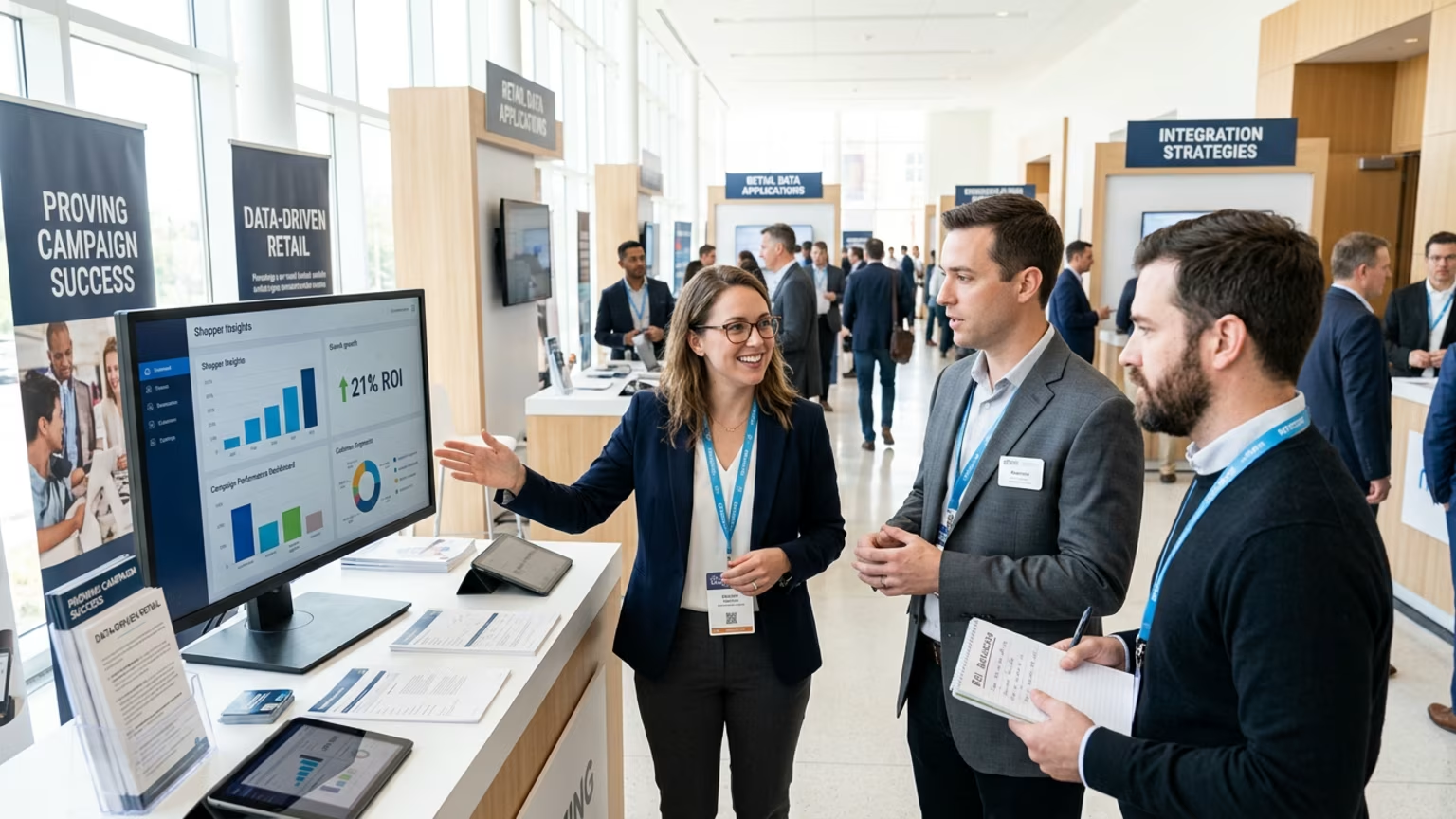
Digital impressions are the most expensive vanity metric in modern retail. The recent integration of Albertsons shopper data with Google changes this dynamic entirely. Brands can now link top funnel video ads directly to physical store purchases.
The Albertsons Media Collective and Google partnership gives consumer packaged goods brands the power to track digital ad exposure down to exact in store sales. This closed loop system turns ambiguous brand awareness campaigns into highly measurable revenue drivers.
You run a massive sampling tour across twenty grocery locations. Your field teams hand out thousands of premium beverage cans over a busy weekend. Consumers smile, nod, and walk away with your product. Monday arrives and the corporate office demands to know how many of those smiles turned into actual retail purchases.
Without a clean data loop, you are left pointing to foot traffic estimates and empty sample boxes. This disconnect makes it nearly impossible to justify future field marketing budgets to a skeptical chief financial officer. Field marketing operators know the frustration of executing flawless physical events that lack digital validation. The inability to connect a physical product trial to a registered cash register scan has always been a major structural flaw.
Agencies often mask this flaw with inflated impression reports and vague brand sentiment surveys. True marketing operators do not want to rely on these soft metrics. They want hard evidence that their live brand experiences drive product movement. The demand for incrementality measurement platforms that prove real return has never been louder.
The Albertsons and Google integration solves this exact attribution problem. Brands can now activate first party data from over fifty million loyalty members across YouTube and Display and Video 360. This means you stop guessing if your target demographic bought your product. According to industry analysts, this integration reflects a major shift where retailers connect advertising exposure directly to transaction outcomes.
This framework unites brand storytelling and performance marketing into one cohesive system. You can build awareness online, drive trial in person, and measure the exact sales lift at the cash register. Google brings advanced artificial intelligence technology to optimize audience targeting in real time. The model constantly learns from actual retail transactions to refine who sees your digital advertisements.
The true strategic advantage lies in closing the loop between the screen and the shelf. A shopper might watch a recipe video on YouTube on a Wednesday afternoon. That same shopper walks into an Albertsons store on Saturday and experiences a live product demonstration. When they scan their loyalty card at checkout, the system credits that sale back to the initial video impression and the in store activation.
Marketing leaders must stop treating digital media and field experiential tactics as separate silos. You have to weave them together to build a continuous path to purchase. If your team needs help structuring this hybrid approach, you should book a strategy call with our operations team. We build the connective tissue between online reach and real world trial.
The retail media environment is experiencing a massive competitive arms race. Kroger previously acted as a first mover by offering YouTube reporting capabilities. Albertsons has now answered back with an infrastructure that supports thirty six million weekly shoppers. Brands now have access to massive loyalty populations across multiple national grocery chains.
This scale forces consumer packaged goods brands to rethink their entire media buying strategy. You can no longer rely on a single retail partner to drive all of your physical attribution. Marketing operators must negotiate data access with multiple retailers to build a comprehensive national campaign. The winners will be the brands that master multiple shopper data platforms simultaneously.
The real advantage of this Google partnership is not just the volume of data. The true competitive moat is the velocity of the artificial intelligence optimization. The system retrains its models continuously based on actual retail sales feedback.
Your campaign does not have to wait for a monthly reporting cycle to understand what is working. If a particular audience segment buys more product on a Tuesday, the system adjusts the media spend by Wednesday. This rapid feedback loop mimics the agility of direct to consumer brands. Grocery brands can finally optimize their campaigns with the same speed and precision as online retailers.
The system handles the complex matching between online profiles and offline grocery carts automatically. You do not need an entire team of data scientists to manually scrub the information. Google integrates this reporting directly into the tools your media buyers already use daily. This removes the technical friction that previously kept field marketing data isolated.
Even with this advanced technology, marketing operators must remain vigilant about inherent data limitations. This integration only tracks purchases made within the Albertsons ecosystem. It completely ignores sales at competitor grocery stores, warehouse clubs, and independent retail shops.
A consumer might see your targeted YouTube advertisement and decide to buy the product at a local corner store. That particular transaction will not register in the Albertsons attribution model. You must still run traditional control group tests to understand the full incremental lift of your campaigns. Smart field marketers use this data as a powerful indicator rather than an absolute total of all market activity.
Implementing this strategy requires precise coordination between your digital team and your field marketing operators. You cannot simply turn on digital ads and expect a live event to magically perform better. A disciplined sequence of events must occur to maximize your Return on Investment.
This playbook moves your brand away from hopeful guessing and toward calculated precision. Every dollar spent on field sampling gets backed by a digital footprint that proves its worth.
Marketing directors face constant pressure to defend their field budgets against digital ad spend. Digital marketing teams can produce neat spreadsheets showing clicks and views. Field marketers often struggle to compete with that level of apparent precision. This Albertsons integration levels the playing field for experiential operators.
You can now walk into a budget meeting with the exact same level of data confidence as your digital counterparts. You can prove that Costco roadshows that win buyer confidence or targeted grocery sampling events drive measurable revenue. This transforms the conversation from a defense of expenses into a presentation of profits. CFOs approve budgets that come with clear financial validation and predictable returns.
Tracking the right data separates successful campaigns from expensive failures. You must clearly distinguish between the metrics that gauge live event health and the metrics that prove financial success. Lead metrics show you the immediate pulse and operational flow of your live experiential event. You must track total engaged conversations, physical samples distributed, and on site lead captures.
These lead indicators tell your field managers if the brand ambassadors are hitting their engagement targets. If sample distribution falls behind schedule, your team can make immediate on site corrections. Lag metrics serve a completely different purpose for your executive leadership team. Lag metrics prove the actual Return on Investment to your corporate office.
You should monitor exact item sales lift, repeat purchase rates among loyalty members, and the exact customer acquisition cost. When you track campaign effectiveness using robust attribution models, your department transforms from a cost center into a recognized revenue generator. Clean measurement protocols secure your budget for the next fiscal year.
Keurig Dr. Pepper recently served as the launch partner for this Albertsons and Google integration. According to MediaPost, they used Albertsons shopper data to verify that their YouTube impressions reached their most valuable consumers. They recognized that reaching a broad audience matters far less than validating actual beverage sales.
Our own work mirrors this demand for high impact execution and measurable shopper connection. A VP of Marketing reflected on our partnership: 'Robbie, it was a pleasure working with you and your team. You turned our launch into an experience that connected with shoppers and built lasting excitement for our brand. We're already looking forward to the next project together.'
Our team created a launch experience that resonated with retail shoppers and generated momentum for future collaborations. When brands combine strong digital targeting with flawless physical execution, the results speak for themselves. By blending physical trials with online content strategies, consumer packaged goods companies secure real market share. The days of accepting foot traffic as a primary success metric are officially over.
The strongest brands understand that a screen can introduce a product, but a physical experience builds trust. True retail momentum happens in the quiet space where digital visibility and physical reality finally intersect.

30 Years Experiential & Retail Activation Partner for CPG & Beverage Brands | Multi-Market Demos, Roadshows & Costco/Club Programs That Actually Sell