Robbie Thain
Founder, CEO

Learn how hyper local micro events help brands test messages, products, and creators before scaling into larger tours for Gen Z and neighborhood retail.
A lot of brands still think scale should come first. They plan a big national roadshow, lock a long route, build a large kit, and hope the format works in every city. That is risky. It is also expensive.
A better move in 2026 is to start smaller. Hyper local micro events let a brand test the product story, the setup, the offer, the creator fit, and the audience response before a bigger rollout starts. Instead of betting on 30 cities at once, you learn in five or ten small neighborhoods, then scale what proved itself.
This matters even more with Gen Z. They see a lot of brand content every day. What breaks through is not always the biggest campaign. It is often the experience that feels close, relevant, and built for people like them in a place they already trust.
That is where Makai fits well. This is not about random pop ups. It is about building a field system that helps brands learn fast, capture useful signals, and turn local wins into repeatable mobile sampling tours, brand activations, or promotional campaigns.
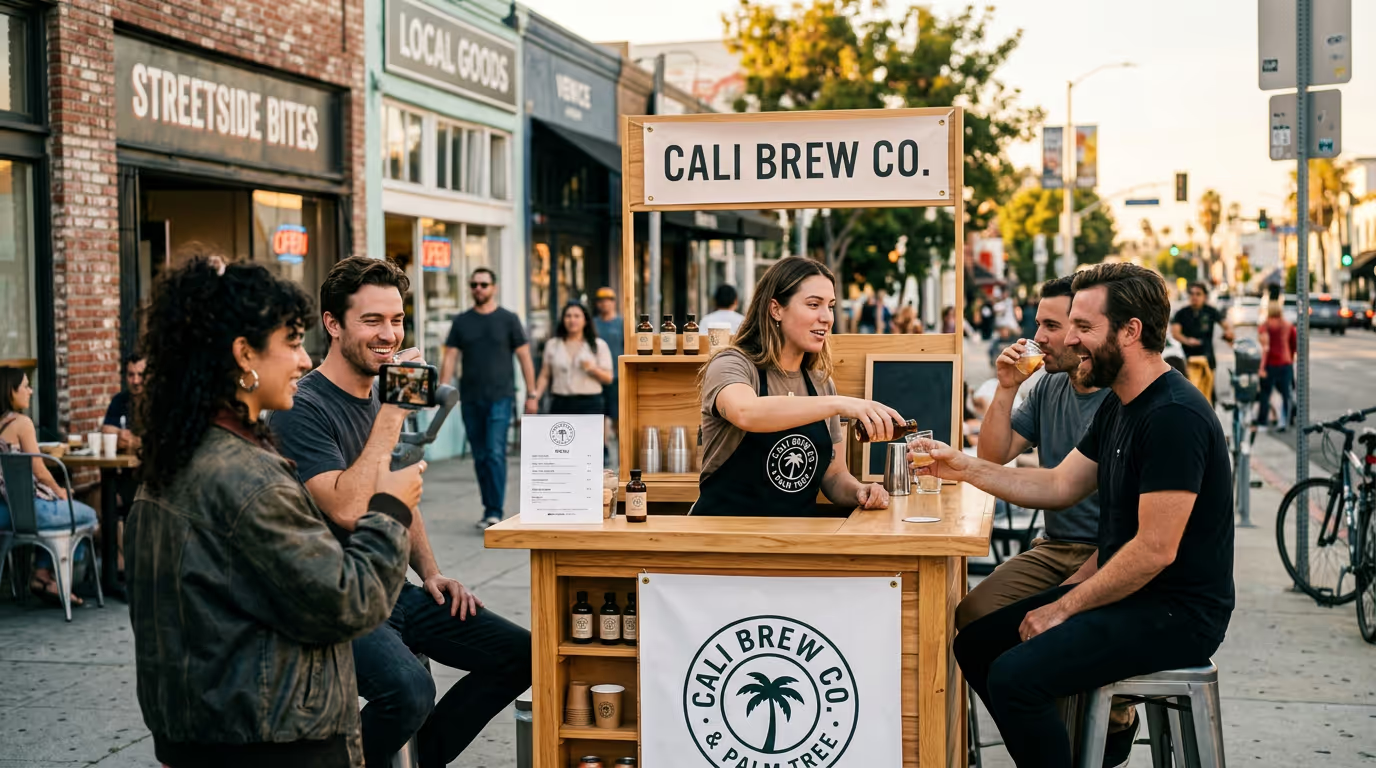
They are small neighborhood scale activations that usually run for one or two days in places like campuses, storefronts, parking lots, parks, or retail adjacencies. They are built to feel local and to answer a few sharp business questions.
They help brands test what works before the expensive rollout starts. You can test messages, products, pricing cues, creators, and formats with less risk.
Because Gen Z responds well to experiences that feel specific, social, and real. A small local event can feel more credible than a broad campaign made for everyone.
Track dwell time, sample rate, opt ins, content creation, retail movement, repeat visits, and signals that say people want the brand back in that area.
It helps you invite the right nearby people before the event, remind them while the event is live, and follow up after the event based on where they engaged.
Yes. The point is not raw scale. The point is better learning. Small events can show which city types, creator types, product stories, and offers deserve bigger investment.
A hyper local micro event is not just a smaller version of a roadshow. It has a different job.
A roadshow usually aims to move product, cover ground, and repeat a proven format. A micro event aims to learn. It is a neighborhood test lab. It helps a brand answer a few clear questions before scaling.
Good micro events are defined by three things.
For a sparkling beverage brand, the question might be which flavor story pulls better in a college area. For a plant based snack brand, it might be whether a protein angle beats a better ingredient angle near gyms. For an EV brand, it might be whether a quick neighborhood test drive works better near a creative district or a commuter hub.
The event only needs to do one or two things well. It does not need to look huge. It needs to feel right for the people who are there.
Geofencing sounds technical, but the idea is simple. You build a location based media layer around the places your likely audience already spends time. Then you use that layer before, during, and after the event to improve turnout and follow up.
Start with the places that already match the audience. That might be campuses, gyms, skate spots, music venues, natural grocery stores, key retail partners, or nightlife blocks. Build a short invite flow that feels local and useful.
The creative should sound like a real invitation, not a banner ad. “We’re popping up two blocks from you on Saturday.” “Try the new flavor near your campus at 2 p.m.” “Local only drop this weekend.”
This is where neighborhood thinking matters. Do not target the whole city if the real goal is one community inside it.
Once the event is live, location based reminders can help nearby people discover it in the moment. The message should stay simple and immediate. Free sample. Local creator live now. One day only. Vote on the next flavor. Something that fits the experience.
On site, the capture path should also stay simple. A QR code to SMS or email opt in is enough for many programs. Ask one useful question. Which flavor won. Which store do you shop. Want early notice when we come back. That is enough to turn foot traffic into a real audience signal.
Post event, you can retarget people who were near the activation or engaged with the invite flow. This is where the long term value shows up. You are not just counting visitors. You are building neighborhood level fan clusters you can use later for tour planning, retail pushes, or future launches.
The privacy rule is simple. Be clear about what people are signing up for and give them control. If the data path feels sneaky, the trust disappears fast.
The best micro event formats are light, modular, and easy to repeat. They should travel well and adapt to different neighborhoods without needing a full rebuild each time.
These work well for beverage, snack, and food brands. Think a compact setup with shade, a small tasting counter, a few stools, and one clear local hook. Maybe a flavor vote. Maybe a local only code. Maybe a recipe tie in for a nearby store.
The goal is not high volume chaos. The goal is a small but sticky experience where people stay long enough to try, react, and talk.
These are useful when the brand wants faster participation. A quick game, a flavor ranking wall, a spin board, or an in person poll can all work. The key is that the interaction teaches the brand something.
You can test product language this way too. Which line feels right. Focus fuel. Calm energy. Clean ingredient snack. Better late shift pick me up. The answers give you better creative for the next market.
Micro creators are often more useful than large creators in this format because they already speak to a specific local community. One or two creators can announce the pop up, host a short segment, and help capture content that feels true to that neighborhood.
This is not about celebrity reach. It is about social proof inside a tight circle.
These are some of the most practical micro events for CPG. Set up near a key retail partner, run a fast sample, and give people a simple shelf locator or store cue right away. This is a clean way to test whether the live moment moves shoppers into store now, not later.
Hyper local events are useful because they make testing cheaper and faster. Before a national tour, brands should use them to test inputs and outputs clearly.
The point is to leave each event with a decision, not just a recap. Keep this message. Drop that one. Use creators like this. Do not use that format again. Move closer to retail. Stay later in the day. These are the choices that make a later tour smarter.
A good micro event program needs field discipline, not just a clever concept. A simple Makai style framework could look like this.
Start with the client’s own signals, sales, social engagement, CRM data, retailer performance, and field intel. Use that to choose five to ten pilot blocks where the audience already exists.
Build one setup that can adapt. One booth design. One sampling flow. One lead capture path. A few swappable creative pieces by neighborhood. This keeps learning cleaner and scaling easier.
Define the geofences, the invite flow, the on site capture path, and the post event follow up path. Align the KPIs with sales and CRM teams before the first stop goes live.
Execute five to ten micro events over four to six weeks. Review results after every stop, not only at the end. Field notes matter as much as the dashboard. What did people ask. What felt confusing. Which creator drove the best traffic. Which retail cue moved people fastest.
At the end of the pilot, the brand should get a clear decision deck. What to keep. What to kill. Which neighborhoods won. Which creator style worked. Which product angle should lead the next wave. That is how small events de risk bigger tours.
If you are a CMO, brand lead, or field lead, ask these questions before funding the bigger tour.
If those answers are clear, the larger tour becomes much easier to justify.
If you want to test neighborhoods before you fund a bigger roadshow, Makai can help build the pilot, run the field program, and turn the results into a smarter tour plan. Start with Request a proposal, review where we work, or explore experiential marketing and mobile sampling tours for the next phase.

30 Years Experiential & Retail Activation Partner for CPG & Beverage Brands | Multi-Market Demos, Roadshows & Costco/Club Programs That Actually Sell


