Robbie Thain
Founder, CEO

The event stage rental market is projected to hit $177.7 billion by 2033. Learn how brands use mobile staging to scale experiential marketing campaigns.

The global event stage rental market is projected to reach $177.7 billion by 2033. This massive financial commitment proves that brands are returning aggressively to physical environments to capture consumer attention. Marketing leaders understand that buying behavior changes when people interact with a product in real life.
Scaling live activations requires shifting away from custom builds in every city toward modular staging and mobile platforms. This approach allows brands to execute predictable and high converting field campaigns without losing control of logistics.
Executing a national roadshow or managing a multi city expo presence often descends into operational chaos. Field marketing directors routinely face delayed shipments and unpredictable union labor costs at different venues. Industry data shows North America holds a thirty one percent share of the global staging market. The U.S. drives over eighty percent of this regional demand.
Broader market projections from the U.S. Chamber of Commerce indicate that party and event rentals alone will exceed $8.15 billion by 2033. This high demand means competition for premium stage space and reliable contractors is fiercely intense. Brand teams spend more time putting out logistical fires than talking to potential buyers. A custom booth build might look great on a rendering but falls apart when transported across the country.
Teams frequently arrive at the venue to find damaged materials or missing structural hardware. This lack of uniformity causes inconsistent brand presentation and directly harms consumer trust. Production costs escalate rapidly with stage rentals varying widely across different markets. A portable riser for a simple podium might cost five hundred dollars.
A full festival mobile stage rental can quickly exceed ten thousand dollars. Additions like custom lighting trusses and compliance ramps can inflate your budget by fifty percent. Without a standardized physical footprint, capturing meaningful data becomes entirely impossible. Staff members are too stressed by setup complications to focus on lead generation.
The mission shifts from driving product trials to simply surviving the grueling event schedule. Regional market entry campaigns fail when the physical execution does not match the premium nature of the product. Using a solid framework for experiential marketing brief templates helps prevent these early missteps.
The most effective way to eliminate event chaos is treating your physical footprint like a predictable product. Analysts project the broader event planning and management sector will hit $380.1 billion by 2032. This massive growth relies heavily on fast and repeatable staging solutions. Using mobile stages on vehicles or trailers provides immediate infrastructure that scales across locations.
A modular approach means your physical environment travels intact and sets up in mere hours. You completely remove the dependency on venue specific rigging and unpredictable local contractors. Trailer stages provide a consistent backdrop for product sampling and direct sales conversations. This fixed cost model protects your activation budget from sudden labor spikes.
Industry leaders continually expand their global event portfolios. These massive production companies increase their reliance on modular stage rentals to maintain profit margins. Production experts note that companies supporting large scale productions boost overall stage rental requirements. Smart marketers adopt these same scalable staging tactics for their brand activations.
We blend physical and digital experiences by integrating QR codes, mobile technology, and real-world activations into a cohesive layer across retail, event, and tour experiences. Phygital is not a standalone service but an upgrade we apply to many types of experiential work to drive connected results. When the physical stage sets up quickly, the team can focus entirely on driving these connected digital interactions.
This structured strategy bridges the gap between field operations and retail success. When the footprint is reliable, you can confidently tell your retail partners where and when you will generate local demand. Brands use this methodology to support new product launches and strengthen retailer confidence. If your team needs to systematize field execution, it is time to Book a strategy call. Integrating reliable mobile staging makes nationwide experiential marketing much more manageable.
Building a touring strategy requires strict operational discipline to maximize Return on Investment. You need a clear sequence of actions to move from concept to a live consumer interaction. This operational playbook guarantees your team executes flawlessly across multiple markets.
A mobile stage activation is only valuable if it generates measurable pipeline and retail velocity. Marketing operators must separate vanity attendance numbers from actual business impact. Tracking the right indicators proves the financial value of the physical footprint. Teams need experiential marketing dashboards that reflect real business outcomes.
Lead metrics dictate the immediate health of your activation during the live event. Track the number of verified product trials per hour of operation. Monitor the dwell time of consumers engaging with the mobile stage environment. Count the volume of direct digital scans or coupon downloads initiated on site.
These exact indicators tell your field managers if the current location is generating enough raw interest. If initial foot traffic is low, the team can pivot their intercept strategy immediately. Real time data allows operators to fix problems before the event concludes. A beautiful stage means nothing if the local crowd ignores the activation completely.
Lag metrics prove the long term financial impact of the touring event strategy. Measure the specific sales lift at regional retail locations surrounding the activation site. Calculate the precise cost per acquisition by dividing the total stage rental budget by new customers gained. Track the redemption rate of digital offers distributed during the live event.
These hard figures give the executive team exact proof of campaign profitability. They connect the transient energy of a live event directly to the permanent balance sheet. Providing concrete numbers justifies future investments in physical field marketing. This disciplined reporting separates professional operators from amateur event planners.
A premium hydration brand needed to drive immediate trial across twenty major consumer festivals and retail parking lots. Relying on custom tent builds for each stop was draining their budget and exhausting their field teams. They pivoted to a fully branded mobile trailer stage that could be deployed by a small team quickly. Setup time dropped from a full day to under two hours.
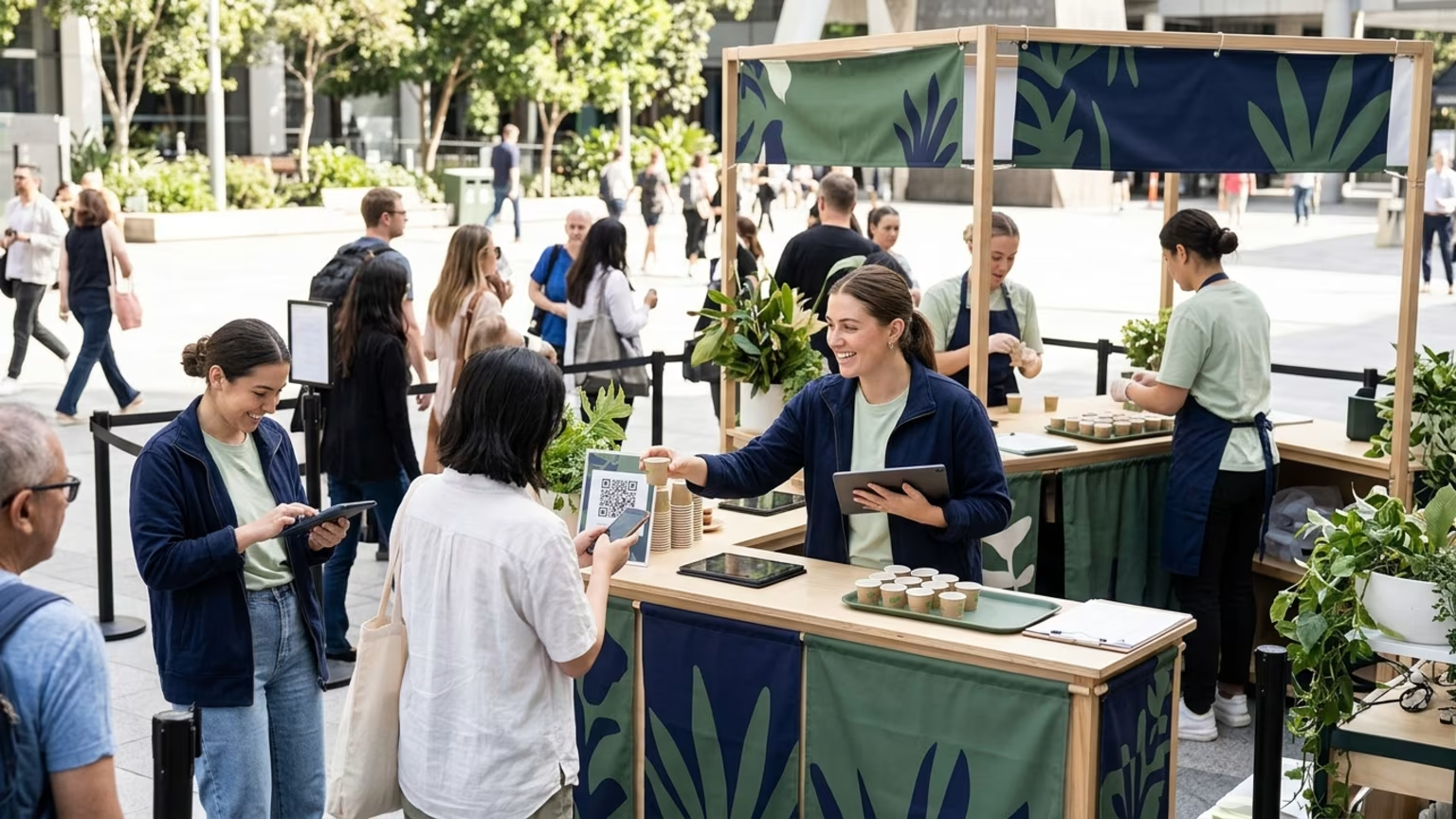
This operational shift changed their entire consumer engagement model. The stage featured built in sampling stations and integrated digital screens for instant data capture. With rapid setup times, the brand ambassadors spent their energy intercepting consumers instead of building temporary structures. The stage served as a highly visible anchor point that cut through the noise of crowded festival environments.
The financial results validated the modular approach completely and immediately. The brand recorded a massive increase in verified product trials per activation hour. Retail partners near the activation sites reported immediate stock depletion of the featured product lines. By standardizing the physical stage, the brand turned a logistical headache into a repeatable revenue engine.
This success story illustrates the true power of mobile staging for consumer goods. Removing friction from the physical setup process naturally increases the quality of the actual marketing work. When logistics disappear into the background, human connection takes the main stage.
The physical space a brand occupies in the real world communicates its internal discipline. When the structure is solid and the execution is calm, the consumer feels the confidence of the product long before they ever take a sip.

30 Years Experiential & Retail Activation Partner for CPG & Beverage Brands | Multi-Market Demos, Roadshows & Costco/Club Programs That Actually Sell