Robbie Thain
Founder, CEO

Build an integrated field ops dashboard connecting staffing, logistics, and CRM data to prove experiential marketing ROI and drive regional retail sales lift.
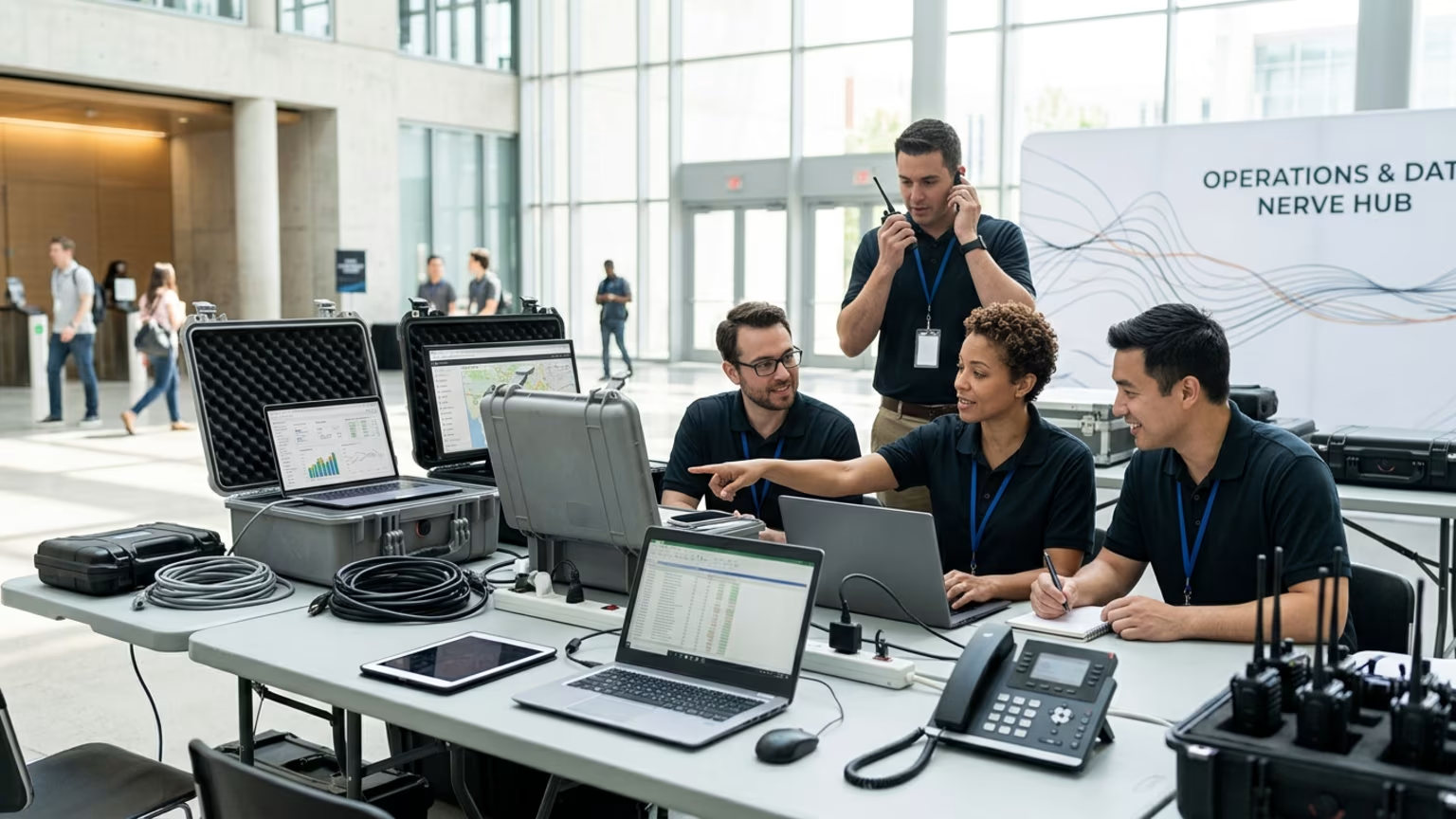
A field manager stands at booth 402 with three dead tablets and a missing pallet of samples. Across the country, the CMO texts to ask if the activation is driving retail foot traffic. The brand ambassador team smiles at passing attendees with no system to capture leads. This disconnect turns expensive physical footprints into unmeasurable guesswork.
A centralized operations and data nerve hub transforms live event chaos into measurable business outcomes. By connecting staffing schedules and event calendars directly to point-of-sale data, marketing leaders can prove the true financial value of their experiential investments.
Modern field marketing requires total alignment between corporate strategy and local execution. Brands spend heavily on high-traffic activations and premium trade show spaces. Teams hand out thousands of samples and scan countless badges. The data from these interactions often disappears into isolated spreadsheets. This fragmented approach leaves marketing leaders guessing which markets actually perform best.
The reality on the event floor often looks like managed chaos. Brand ambassadors arrive at a location to find missing promotional materials or incorrect product shipments. Regional managers spend their entire weekend putting out logistical fires instead of optimizing consumer interactions. When the warehouse operates on a different system than the field staff, expensive errors compound quickly. These operational blind spots bleed the marketing budget and destroy the potential for accurate reporting.
Event marketing job requirements increasingly demand deep data proficiency alongside standard logistical skills. Regional coordinators must balance complex staffing schedules against regional point-of-sale metrics. A lack of real-time visibility means field leaders cannot redeploy underperforming teams mid-flight. They end up waiting for post-event wrap reports to realize a major market activation underperformed. This delay prevents any meaningful optimization.
The pressure to justify event spend mounts rapidly in corporate boardrooms. Executives want to see exactly how a weekend sampling tour impacted local retail velocity. They need clear evidence that moving pallets of product translates into a positive Return on Investment. Tracking real-world consumer engagement with isolated tools produces fog instead of evidence. The modern Chief Marketing Officer expects physical activations to deliver the same precise analytics as a digital advertising campaign.
Beyond simple inventory counts, the human element of experiential marketing often suffers from poor data integration. Brand ambassadors are the face of your company. When they lack modern tools to track their hours, breaks, and shift locations, morale plummets rapidly. High turnover in the field directly reduces the quality of consumer interactions. A disorganized event floor signals to both staff and consumers that the brand lacks operational discipline.
A functional nerve hub unites logistics and revenue tracking under a single digital roof. The strategy requires breaking down walls between the warehouse team and the CRM administrators. Every asset from the sampling truck routing to the ambassador payroll must feed into a central dashboard. This complete visibility allows marketing operators to treat field events like high-performance digital campaigns.
We create experiential marketing programs built to connect emotion with action. Our process blends creativity, strategy, and data to guarantee every brand interaction drives measurable results. In our experience, campaigns fail when operational logistics operate blindly from sales targets. A brand ambassador might have great conversations on the floor. Without an integrated system, those conversations never turn into qualified pipeline or retail lift.
The core of this strategy involves standardizing data collection across every physical touchpoint. Ambassadors use identical software to clock in, report inventory, and capture consumer feedback. This uniformity prevents data gaps and provides regional managers with reliable hourly updates. When field operators rely on uniform reporting, leadership gains the clarity needed to make quick budget adjustments. Standardization is the foundation of any scalable field operation.
Connecting these systems requires intentional planning before the first truck leaves the lot. Teams must map the data flow from a tablet on the expo floor straight to the executive dashboard. Proving the financial impact of live activations becomes simple when sales managers can see event data alongside daily retail metrics. This operational rigor replaces qualitative guesses with hard performance metrics. A strong strategy dictates exactly what data points matter before the event begins.
Establishing this nerve center requires a strong partnership with your IT and revenue operations teams. Field marketing can no longer operate as a siloed creative department. The technical architecture must securely pass consumer data from public event spaces into highly protected corporate databases. This cross-functional alignment protects consumer privacy and meets corporate security standards. Operations managers must prioritize secure data collection as highly as booth design.
A unified command center allows field teams to react dynamically to changing ground conditions. If a local festival draws smaller crowds than expected, managers can quickly reroute brand ambassadors to a high-traffic grocery location nearby. This agility protects the marketing budget and maximizes consumer exposure. Operators with integrated dashboards control the field instead of reacting to it.
Building a reliable operational hub takes discipline and clear cross-functional communication. Teams must follow a strict integration process to merge physical event data with corporate sales tracking. The execution requires precise steps to align local brand interactions with broader corporate revenue goals.
Following this execution playbook guarantees your live activations produce clean and actionable intelligence. Every tactical step aligns local brand interactions with broader corporate revenue goals. Optimizing field staffing models requires this exact blend of structured planning and real-time data flow. Marketing operators can finally run regional campaigns with precision and absolute financial accountability.
Executives demand proof that live brand experiences directly impact the bottom line. Measuring this impact requires tracking both immediate operational outputs and long-term business outcomes. The command center must highlight specific lead metrics and lag metrics to tell the complete story. A dashboard full of vanity metrics will never satisfy a board of directors looking for financial returns.
Lead metrics track the immediate operational health of the activation on the ground. These include total samples distributed, active dwell time, and the number of qualified badge scans. Field managers monitor these numbers hourly to gauge crowd engagement and staff performance. High lead metrics indicate the team is successfully capturing attention and generating interest in the physical environment. Tracking these points allows teams to correct poor performance before the event ends.
Lag metrics reveal the ultimate financial success of the campaign weeks or months later. These figures include regional retail sales lift, cost per acquisition, and total pipeline revenue generated. A strong experiential dashboard automatically overlays event dates onto sales charts to highlight correlation. Leadership relies on these lag metrics to justify future event budgets and measure total program profitability. These metrics prove the true business impact of field marketing.
Connecting lead metrics to lag metrics forms the basis of accurate experiential marketing reporting. If a high volume of samples leads to zero retail velocity, the operational team must investigate the disconnect. The hub provides the data needed to pinpoint whether the issue was product quality, staffing execution, or poor location targeting. You must track both sides of the equation to build a repeatable success model.
Calculating the specific customer acquisition cost for live events separates amateur programs from professional operations. By dividing the total activation cost by the number of new verified customers, operators gain a clear benchmark. This benchmark allows marketing leaders to compare field event performance directly against digital channel metrics. When field marketing proves a lower acquisition cost than paid social ads, budgets naturally shift toward live experiences.
We craft experiences that engage all five senses, helping people not just see brands, but feel them, turning moments into meaningful business outcomes. If your brand struggles to capture these numbers from the field, you need a new operational playbook. Book a strategy call with our team to start building an event reporting system that actually works. We build programs that capture the hard data your executive team requires.
A national beverage brand recently launched a massive summer sampling tour across twenty states. They faced intense pressure from regional distributors to prove the tour would drive immediate retail orders. In previous years, their event data consisted of messy spreadsheets submitted weeks after the activations ended. The brand needed a total overhaul of their field marketing operations to satisfy distributor demands. The legacy approach of disconnected tracking simply could not scale.
The marketing team deployed a unified command hub to connect their entire tour apparatus. Staffing schedules, vehicle GPS routing, and daily inventory logs were fed into a single executive dashboard. Brand ambassadors used standardized mobile apps to record thousands of consumer interactions and local grocery store feedback. This system provided the corporate office with a real-time view of every street-level activation. The visibility transformed how the brand managed their physical assets.
The data hub allowed the brand to make highly aggressive strategic shifts mid-tour. When the dashboard revealed poor engagement at outdoor music festivals, the team instantly rerouted their sampling trucks to busy retail parking lots. This pivot was executed in days instead of months. The regional distributors received daily reports showing exact sample volumes alongside local store addresses. This rapid deployment of data built immense trust with retail partners.
The campaign ended with undeniable proof of success backed by clean operational data. The dashboard clearly correlated specific local sampling events with a measured increase in regional point-of-sale velocity. The marketing director used this hard evidence to secure a larger budget for the next product rollout. By treating their field operations as a structured data environment, they turned physical product trials into predictable business growth.
A powerful nerve center changes everything about how a brand executes in the physical world. Marketing leaders trade chaotic weekend phone calls for clear operational dashboards. Live consumer interactions transform from fleeting moments into permanent business assets. Build the right system to take total command of your next experiential program.

30 Years Experiential & Retail Activation Partner for CPG & Beverage Brands | Multi-Market Demos, Roadshows & Costco/Club Programs That Actually Sell